You inject once a week, and every week you have to decide: where does it go this time? Stomach, thigh, arm, and is the one you picked actually as good as the others?
This page shows the three areas the labels name, a rotation pattern you can follow without thinking, the answer to "which site is best for results", and where not to inject.
Quick answer: The labels for Ozempic, Wegovy, Mounjaro and Zepbound name three areas: the stomach (at least 2 inches from the belly button), the thigh, and the back of the upper arm, which several labels say needs someone else's help. You may reuse an area, but not the exact spot from last time. Skip skin that is tender, bruised, red, hard, scarred, pitted or lumpy. The labels report similar exposure from all three areas, so no site is best for results. Ask the prescriber or a pharmacist to show you.
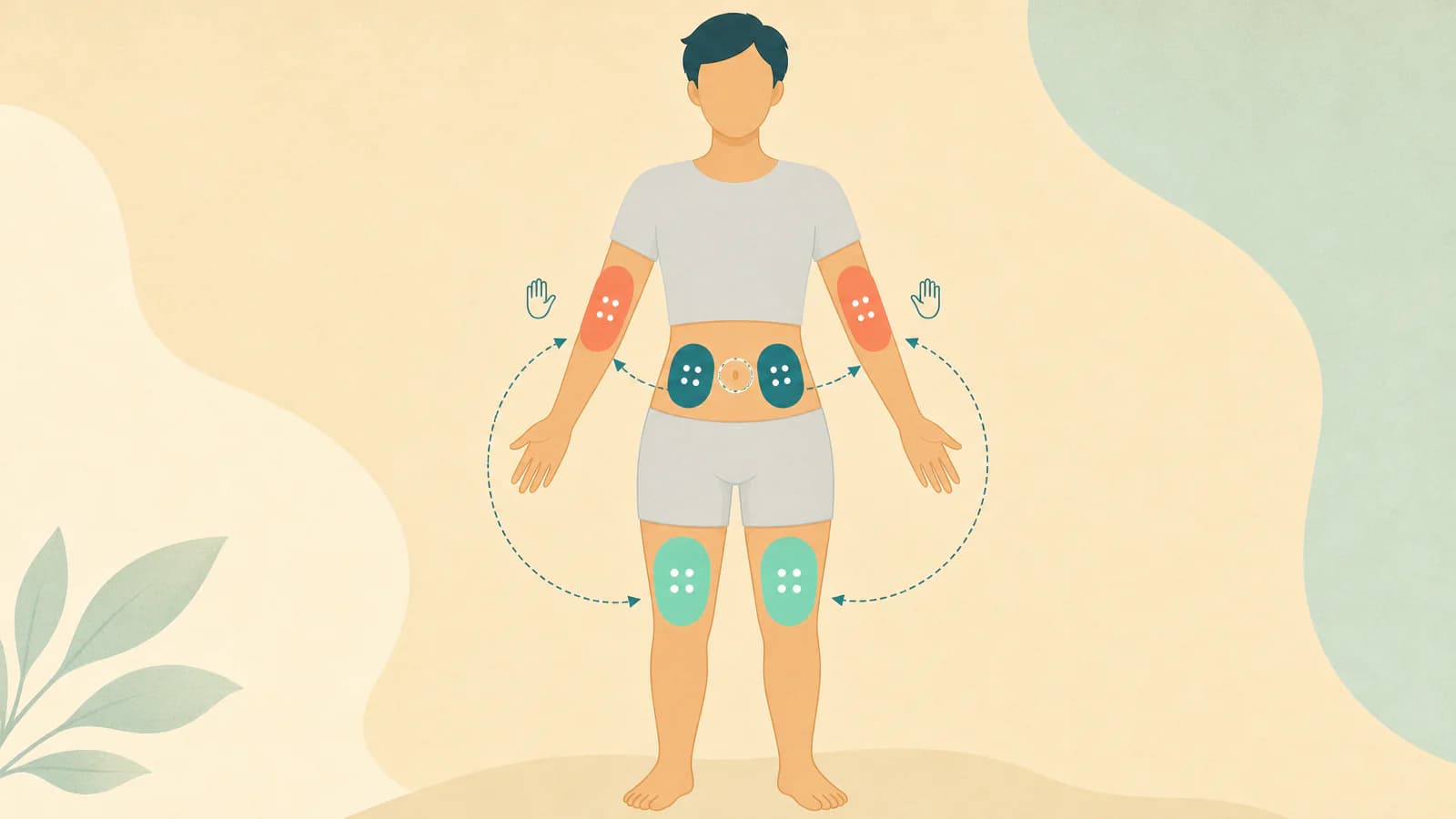
- Stomach. At least 2 inches (5 cm) from the belly button.
- Keep-clear ring. Drawn as a guide around the belly button, not to scale.
- Front of the thigh.
- Back of the upper arm (H). Several labels say this needs someone else's help, so it is not in the loop.
- Week 1: Stomach, left side
- Week 2: Stomach, right side
- Week 3: Left thigh
- Week 4: Right thigh
- Week 5 onward: Repeat the loop, picking a fresh spot inside each area (the open dots).
Left and right are as you see yourself looking down. The loop is an example the editors built, not medical advice and not taken from the labels: any pattern that avoids the last spot works. Follow the Instructions for Use in your box, and ask the prescriber or a pharmacist to show you the technique.
Where can you inject Ozempic, Wegovy, Mounjaro and Zepbound?
All four are injected under the skin. The pharmacology sections of the labels report similar exposure whether the medicine goes into the abdomen, thigh or upper arm. Instructions for Use differ a little by product and pen, so read the ones in your box.
| Area | What the labels say | Good to know |
|---|---|---|
| Stomach (abdomen) | At least 2 inches (5 cm) from the belly button. | Wegovy's Instructions for Use name the lower stomach. |
| Thigh | The front of the thigh. | Named on all four labels. |
| Back of the upper arm | The back of the upper arm. | Ozempic, Mounjaro and Zepbound say only with help from someone else, and so does the Wegovy prefilled syringe. Some other Wegovy instructions list the upper arm without that note, so check yours. |
How to rotate injection sites: a simple weekly pattern
Rotation, according to the labels, means a different spot every time. You may use the same body area the next week, but not the same spot within it. Ozempic's label says to use a different site each week when injecting in the same region, and the Medication Guides say not to use the same site for each injection.
The labels do not prescribe a pattern. Here is one the editors built, as an example and not as medical advice. Any pattern that avoids the last spot works:
| Week | Where |
|---|---|
| 1 | Stomach, left side |
| 2 | Stomach, right side |
| 3 | Left thigh |
| 4 | Right thigh |
| 5 onward | Repeat the loop, picking a fresh spot inside each area |
Three habits make it stick:
- Pick a pattern you will actually follow. A simple one beats a perfect one.
- Note the site on your phone or a calendar right after each injection, so you are not guessing a week later.
- Use the back of the upper arm only if someone else injects.
Want a rotation schedule built around the sites you really use? The injection photo check describes what it sees at a site, and its plan includes a rotation calendar. It is a description, not a diagnosis.
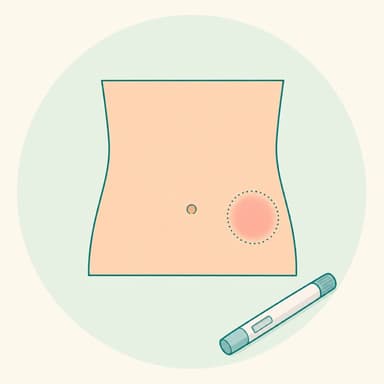 Reaction where you inject your GLP-1? Tap to add a photoAI describes what it sees and whether it looks like a common reaction or something to show a doctor, and you get a care and rotation plan as a PDF. It does not diagnose. One check is $4.99.Add a photo
Which injection site is best for results?
None, according to the labels. They report similar exposure from the abdomen, thigh and upper arm, so the choice is mostly about comfort, reach and the condition of your skin. Following the Instructions for Use consistently matters more than the body part.
One practical tip comes from Wegovy's Instructions for Use: if you have problems injecting, change to a firmer injection site such as the upper leg or upper arm, or consider standing up while injecting into the lower stomach.
Where not to inject
The Instructions for Use are specific. Do not inject into:
- Skin that is tender, bruised, red, hard or scaly.
- Scars, stretch marks or damaged skin.
- Pits, thickened skin or lumps.
- Skin within about 2 inches of the belly button.
- The exact spot you used last time.
Why the lumps and pits? The tirzepatide Instructions for Use (Mounjaro and Zepbound) say rotating within your chosen area lowers the risk of lipodystrophy (pits or thickened skin) and localized cutaneous amyloidosis (skin with lumps). International injection guidelines written for insulin, which is background and not a GLP-1 trial, make the same point about fatty lumps under the skin: do not inject into them, and correct site rotation helps prevent them.
A few habits that make injections smoother
- Clean the spot and let it dry. The Instructions for Use say to use an alcohol swab or wipe (Wegovy also allows soap and water) and to let the skin dry before injecting. Do not touch the spot after cleaning.
- Use a new needle for each injection where your pen uses needles. The Ozempic and Wegovy pens say so.
- Follow your own Instructions for Use. Pens differ.
- Ask the prescriber or a pharmacist to show you the technique if you are unsure. Talk to a doctor about your routine, especially in pregnancy, while breastfeeding, on other medicines, or with kidney or liver disease.
If a spot reacts
Mild redness, itch and bruising are common. A 2026 review lists pain, bleeding, redness, bruising, lumps, itching and swelling among reported reactions, most of them mild to moderate. See injection site reactions: what is normal and what is not.
Two situations are not mild:
- Emergency (call 911 or go to the ER): swelling of the face, lips, tongue or throat, trouble breathing or swallowing, fainting or feeling dizzy, a very rapid heartbeat, or a severe rash or itching. Tell the emergency team which medicine you use.
- Same-day doctor: redness that keeps spreading, hot, swollen, painful skin, pus, a fever, or a hard, painful lump that is growing. The NHS notes that skin that is painful, hot and swollen can be a skin infection, usually red, though less obvious on brown and Black skin, and that early antibiotics can stop it getting more serious.
If irritation at the spot does not improve with time, the American Academy of Dermatology says to ask the prescriber for injection tips.
Related guides
- Injection site reactions: what is normal and what is not, for red, itchy, bruised or lumpy spots.
- GLP-1 side effects on skin, hair and face, for everything else people notice.
- Skin rash guide, for a rash that is not at the injection spot.
Frequently asked questions
Where is the best place to inject Ozempic?+
The label names the abdomen, thigh and upper arm, and reports similar exposure from all three, so no spot is better for results. Choose one you can reach and keep skin healthy by moving to a fresh spot each time. The prescriber or a pharmacist can help you choose.
Can I inject Mounjaro or Zepbound in the thigh?+
Yes. The labels and Instructions for Use list the thigh, along with the stomach, kept at least 2 inches from the belly button. Choose a different spot for each injection.
Can I use the same injection site every week?+
You may use the same area, but not the same spot. The Medication Guides say to change your injection site with each injection and not to use the same site for each one.
How far from the belly button should I inject?+
At least 2 inches (5 cm), according to the Instructions for Use for Ozempic, Wegovy, Mounjaro and Zepbound when injecting in the stomach.
Is the stomach or the thigh better for results?+
Neither, according to the labels. Their pharmacology sections report similar exposure whether the medicine goes into the abdomen, thigh or upper arm. Let comfort, reach and the condition of your skin decide.
Can I inject into the back of my upper arm myself?+
The Instructions for Use for Ozempic, Mounjaro and Zepbound say the back of the upper arm only with help from someone else, and the Wegovy prefilled syringe says the same. If you inject alone, the stomach and thigh are easier to reach.
What if I get a lump or bruise at a spot?+
The labels say not to inject into skin that is bruised, tender, hard, pitted or lumpy, so use a fresh spot while it heals. If a lump is hard, painful, hot or growing, or you have spreading redness, pus or a fever, see a doctor the same day.
How do I keep track of which spot I used last?+
Note the area on a phone or calendar right after each injection. A repeating pattern, such as left stomach, right stomach, left thigh, right thigh, means you never have to guess.
Sources
- Novo Nordisk. Ozempic (semaglutide) injection prescribing information, Medication Guide and Instructions for Use. DailyMed, label revised June 2026. DailyMed
- Novo Nordisk. Wegovy (semaglutide) injection prescribing information, Medication Guide and Instructions for Use. DailyMed, label revised June 2026. DailyMed
- Eli Lilly and Company. Mounjaro (tirzepatide) prescribing information, Medication Guide and Instructions for Use. DailyMed, label revised September 2026. DailyMed
- Eli Lilly and Company. Zepbound (tirzepatide) prescribing information, Medication Guide and Instructions for Use. DailyMed, label revised September 2026. DailyMed
- Frid AH, Kreugel G, Grassi G, et al. New insulin delivery recommendations. Mayo Clinic Proceedings. 2016. PubMed 27594187
- Elgindi D, Petronic-Rosic V. Glucagon-like peptide-1 receptor agonist-associated injection site and dermatologic reactions. Clinics in Dermatology. 2026. PubMed 42692277
- American Academy of Dermatology. How can GLP-1 drugs affect my skin, hair, and nails? Updated February 2026. aad.org
- National Health Service (UK). Cellulitis. nhs.uk, accessed October 2026. nhs.uk
This article is for general education and is not medical advice. It does not replace a consultation with a qualified clinician. If a symptom worries you, see a doctor.