You are looking at a rash on your own skin and typing "what is this rash" into a search bar, scrolling past photos that all look a little like yours.
Skip the scrolling. This page is a skin rash identifier made of five questions, not a verdict: shape, place, itch or pain, spread and fever. Then it hands you to side-by-side guides for the look-alikes people confuse most.
Short version: Look at the shape and edge, where it sits, whether it itches or hurts, how fast it appeared or spread, and whether you have a fever. Those five clues sort most common rashes. A few signs, such as fever with a rash or spots that do not fade under a pressed glass, mean you should get care the same day.
Rash in front of you and no idea where to start? Add a photo and the AI photo check describes what it sees and compares it with common rashes.
 Tap to add a photo of the rash on your skinAI describes what it sees, which common rashes it looks like, and when to see a doctor. It does not diagnose. One check is $4.99.Add a photo
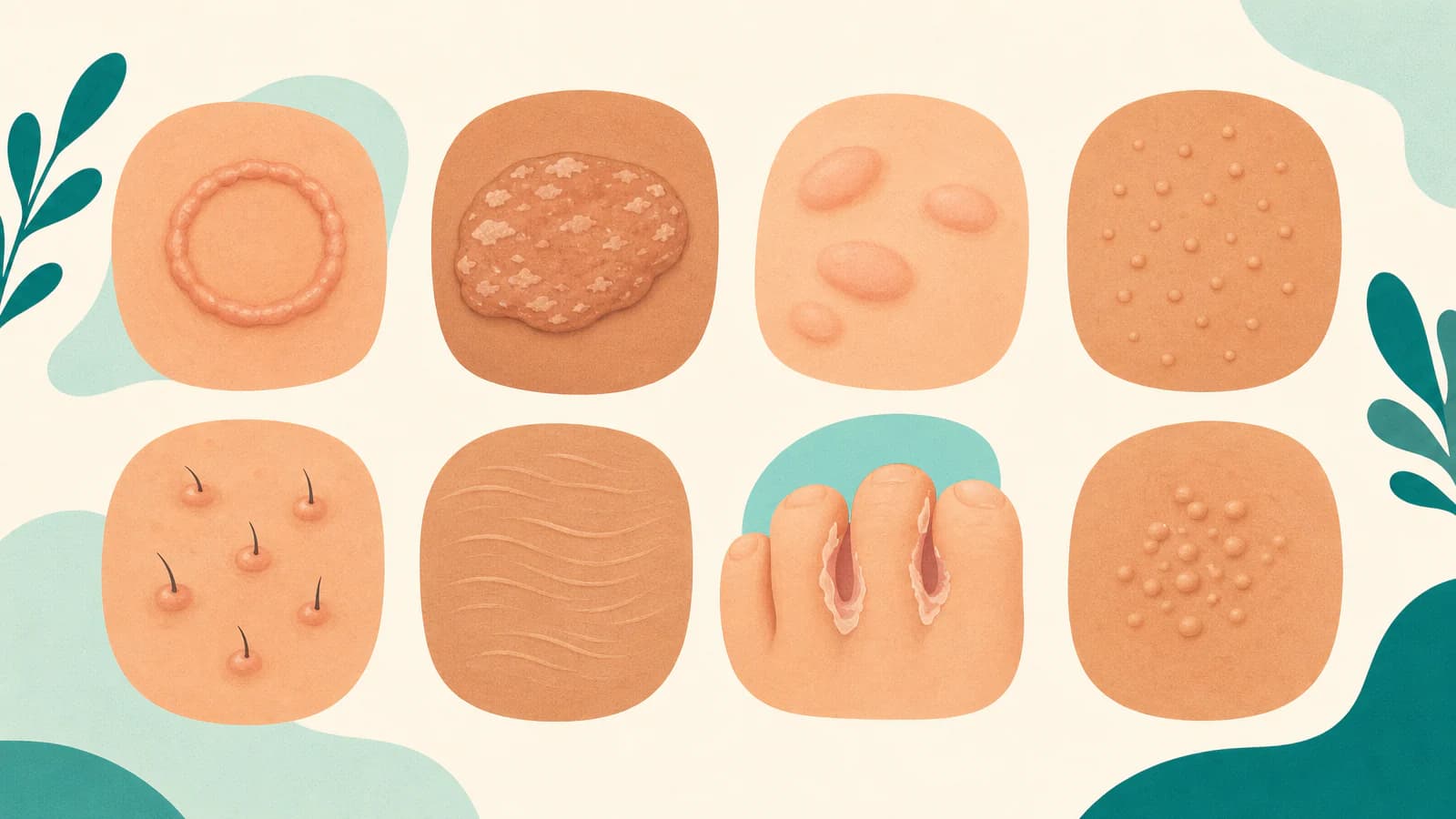
How to read a rash in one minute
- Shape and edge. A ring with a raised, scaly edge and a smoother middle points toward ringworm. Thick, sharply outlined patches with silvery scale point toward psoriasis. Dry, blurry-edged, itchy patches point toward eczema. Raised welts that come and go within a day point toward hives. Tiny same-size dots on sweaty skin point toward heat rash. Small bumps around hairs point toward folliculitis or ingrown hairs. Thin wavy lines with a dot at one end, between the fingers or on the wrists, point toward scabies.
- Where it sits. Eczema favors creases such as the inside of the elbow and behind the knee. Psoriasis favors the outside of the elbows and knees, the scalp and the lower back. Scabies favors finger webs, wrists and the waistline. Bed bug bites land on skin uncovered in bed. A rash exactly under a watch, bracelet or belt buckle suggests a reaction to metal such as nickel.
- Itch, pain or burning. Itch is typical of eczema, hives, scabies, bites and fungal rashes. Pain, tenderness or burning point toward infection, shingles or deep folliculitis. Hot, swollen, spreading red skin can be cellulitis and needs same-day care.
- How fast it came and spread. Hives appear in minutes to hours, and each welt is gone within about a day. Bites show up within hours. Heat rash follows heat and sweat. Contact reactions follow touching something new, within hours to a couple of days. Ringworm and psoriasis grow over days to weeks. Scabies itch builds over weeks. Eczema flares in cycles.
- Fever or feeling unwell. A rash with fever, severe headache, stiff neck or confusion is urgent. So are spots that do not fade under a pressed glass, blisters or peeling on the mouth, eyes or genitals, and a fast-spreading rash in a baby.
- Who else has it. Several people at home itching points toward scabies or bed bugs. A pet with scaly, bald patches points toward ringworm. Shared gym mats and sports gear can pass on ringworm and folliculitis.
- What changed lately. New soap, detergent, cosmetics, plants, jewelry, medicines, a hot tub, travel, shaving, waxing, a new pet or new bedding all count.
- Skin tone. Redness is easier to see on light skin. On brown and Black skin the same rash often looks darker brown, purple, gray or only a slightly different shade, so go by texture (raised, scaly, rough, bumpy) as well as color. Dark marks can linger after a rash has healed.
Quick lookup: what is this rash on my...
Leg
Shaving, sweat, bites and long days in socks all leave their mark here. Check the backs of the knees and the ankles first.
- Eczema: dry, itchy patches, often behind the knees.
- Bug bites: scattered itchy bumps, with flea bites clustering around the ankles. See hives vs bug bites and bed bug vs mosquito bites.
- Folliculitis or ingrown hairs: small bumps where you shave or wax. See folliculitis vs ingrown hair.
- Ringworm: a growing scaly ring with a smoother middle.
- Contact dermatitis: itch where a plant, lotion or new clothing touched the skin.
- Stasis dermatitis: a rash on the lower legs with swelling, more often in older adults.
- Cellulitis: hot, swollen, spreading red skin that is painful. Same-day care.
Arm
Arms brush against plants, soaps and fabrics. Note whether the rash is in the soft inner elbow fold or on the outer point.
- Eczema: blurry, itchy patches in the inner elbow.
- Psoriasis: thick patches with silvery scale on the outer elbow. See psoriasis vs eczema.
- Ringworm: an itchy, scaly ring. See eczema vs ringworm.
- Hives: puffy welts that move around and fade within a day.
- Keratosis pilaris: rough, tiny skin-colored or red bumps on the upper arms, harmless.
- Contact dermatitis: itch exactly where a new bracelet, watch or plant touched.
Face
Facial skin is thin and reacts fast to new products, weather and stress.
- Eczema: dry, itchy, flaky patches on the cheeks or chin.
- Seborrheic dermatitis: red patches with greasy flakes around the nose, brows and hairline.
- Contact dermatitis: a reaction to a new skincare product or fragrance.
- Rosacea: flushing and small bumps across the cheeks and nose.
- Acne: pimples, whiteheads and clogged pores.
- Hives: sudden welts that come and go. Swelling of the lips or eyelids needs urgent care.
- Shingles: painful blisters in a band on one side of the face. Urgent, especially near the eye.
Neck
The neck traps sweat and rubs against collars, necklaces and perfume.
- Heat rash: tiny dots in folds or under tight collars. See heat rash vs hives.
- Contact dermatitis: an itchy patch shaped like a necklace or where perfume landed.
- Eczema: dry, scaly, intensely itchy patches.
- Ringworm: a scaly ring that slowly widens.
- Ingrown hairs: tender bumps at the nape or beard line.
- Hives: sudden itchy welts that fade quickly.
Hand
Hands meet everything: soap, sanitizer, cleaning products, gloves and germs.
- Hand eczema: dry, cracked skin, or tiny deep itchy blisters on the sides of the fingers.
- Contact dermatitis: a reaction to soap, sanitizer, rubber gloves or cleaning products.
- Scabies: intense night itch and thin wavy lines between the fingers. See scabies vs eczema.
- Psoriasis: thick scaly plaques on the knuckles or palms.
- Ringworm: a distinct scaly patch on the back of the hand.
- Hives: sudden puffy welts.
Foot
Feet spend the day in dark, damp shoes, which fungus likes.
- Athlete's foot: peeling, soggy skin between the toes or fine scale across the sole. See athlete's foot vs dry skin.
- Dry skin: rough, cracked heels with no soggy toe webs.
- Eczema: itchy, scaly patches on the tops of the feet or around the ankles.
- Contact dermatitis: itch from shoe dyes, leather treatments or insoles.
- Psoriasis: thick scaly patches on the soles.
Stomach
Tight waistbands, trapped sweat and metal buttons are the usual suspects.
- Heat rash: tiny dots under a waistband or belt.
- Contact dermatitis: a patch right under a belt buckle, often a nickel reaction.
- Scabies: intensely itchy bumps around the waistline and belly button.
- Hives: raised welts that shift around the trunk.
- Eczema: dry, itchy patches that flare and settle.
- Ringworm: a growing scaly circle.
- Folliculitis: small bumps around body hairs.
- Pityriasis rosea: oval scaly patches along the ribs, often after one larger patch, usually fading on its own over weeks.
Moles, new spots and changing marks are a different topic. For those, use checkmole.com.
Side-by-side guides for look-alike rashes
- Eczema vs ringworm: a round itchy patch, with a blurry edge or a ring.
- Psoriasis vs eczema: thick silvery scale on elbows and knees, or blurry itchy patches in creases.
- Hives vs bug bites: welts that move and fade in a day, or bumps that stay.
- Bed bug bites vs mosquito bites: lines and clusters after sleeping, or scattered puffy welts.
- Scabies vs eczema: night itch, finger webs and others at home scratching.
- Heat rash vs hives: tiny bumps after sweating, or welts that come and go.
- Folliculitis vs ingrown hair: bumps where you shave or wax.
- Athlete's foot vs dry skin: peeling feet, soggy between the toes or rough soles.
Not sure which side-by-side guide fits your rash? Add a photo and let the comparison point you to the right one.
Tap to add a photo of the rash on your skinAI describes what it sees, which common rashes it looks like, and when to see a doctor. It does not diagnose. One check is $4.99.Add a photo
What to write down before you see a doctor
- A clear photo in good light today, and another in a day or two to show how it is changing. You can also try the rash checker.
- The size, compared with a coin.
- When it started, and how fast it spread.
- Whether it itches, burns or hurts.
- New products, medicines, foods or detergents from the past few days.
- Whether anyone else at home is itchy, and whether you have a fever.
Talk to a doctor or pharmacist before treating a rash, especially in pregnancy, while breastfeeding, if you take other medicines, for babies and young children, or with kidney or liver disease.
When a rash should not wait
The rule that matters most: a rash with a fever, or spots that do not fade when pressed, is urgent.
The glass test is simple. Press the side of a clear glass firmly against the spots. If they stay visible through the glass instead of fading, get emergency help. On brown and Black skin the spots are harder to see, so check paler areas such as the palms, soles, inside of the eyelids and the roof of the mouth.
Still not sure what you are looking at? Upload a photo to see how it compares with common rashes. It is a comparison, not a diagnosis.
Tap to add a photo of the rash on your skinAI describes what it sees, which common rashes it looks like, and when to see a doctor. It does not diagnose. One check is $4.99.Add a photo
Frequently asked questions
What is this rash on my skin and how do I find out?+
Start with five clues: the shape and edge, where it sits, whether it itches or hurts, how fast it appeared or spread, and whether you have a fever. Then compare it with look-alike rashes. A doctor can examine the skin and confirm what it is.
Can an app or AI tell me what my rash is?+
A photo check can describe what a rash usually looks like and compare it with common rashes, which helps you ask better questions. It is not a diagnosis. Only a clinician who examines you can tell you what you have.
What does a fungal rash look like compared with an allergic rash?+
A fungal rash such as ringworm often grows slowly into a scaly, raised ring with a smoother middle and may itch only a little. A contact allergy tends to show up as an itchy patch where something touched the skin, often within hours to a couple of days.
How do I tell if a rash is serious?+
Fever with a rash, severe pain, hot spreading red skin, spots that do not fade under a pressed glass, blisters on the mouth, eyes or genitals, swelling of the face or lips, or trouble breathing are urgent signs. A fast-spreading rash in a baby is too.
Is my rash contagious?+
Rashes from fungus (ringworm, athlete's foot), mites (scabies) and some infections can pass to others. Eczema, psoriasis, hives, heat rash and bites themselves cannot. If several people at home itch, think scabies or bed bugs.
What does the glass test mean?+
Press the side of a clear glass firmly on the spots. If they fade, that is a better sign, but a rash with a fever still needs a doctor. If they stay visible through the glass, they have not faded and that needs urgent medical care, especially with fever. On brown and Black skin, check paler areas such as the palms and soles.
What kind of doctor should I see for a rash?+
A primary care doctor can handle most common rashes. They can refer you to a dermatologist if it is stubborn, severe or hard to name.
Does a rash look different on dark skin?+
Often, yes. Redness is harder to see on brown and Black skin, so the same rash can look dark brown, purple or gray. Texture, such as raised, scaly or bumpy skin, is a better clue, and dark marks can stay after it heals.
Sources
- National Health Service (UK). Rashes in babies and children (includes the glass test). nhs.uk, accessed October 2026. Link
- National Health Service (UK). Meningitis. nhs.uk, accessed October 2026. Link
- American Academy of Dermatology Association. Eczema types: Atopic dermatitis overview. aad.org, accessed October 2026. Link
- American Academy of Dermatology Association. Psoriasis: Overview. aad.org, accessed October 2026. Link
- American Academy of Dermatology Association. Hives: FAQs. aad.org, accessed October 2026. Link
- American Academy of Dermatology Association. Ringworm: Overview. aad.org, accessed October 2026. Link
- National Health Service (UK). Scabies. nhs.uk, accessed October 2026. Link
This article is for general education and is not medical advice. It does not replace a consultation with a qualified clinician. If a symptom worries you, see a doctor.