The supplement aisle promises thicker hair, clearer skin and stronger nails. Most of it is guesswork in a nice bottle.
This hub works the other way round. Start with what you can see on your body, find out whether a nutrient is really behind it, then decide what to do. Sometimes that is a supplement. Often it is a blood test, a habit or a doctor.
The short answer
Supplements help skin, hair and nails mainly when you are low in something. The signs on your body tell you what to test; a blood test tells you whether you are low. Then you fill that gap at a sensible dose, with your doctor. The FDA does not approve supplements before they are sold, so quality checks are on you.
- •Supplements help skin, hair and nails mainly when you are low in something. A blood test tells you; the signs on your body tell you what to test.
- •The strongest links: protein and iron for shedding, iron for brittle or spoon-shaped nails, zinc for inflamed acne, and real deficiencies for specific skin signs.
- •Biotin helps only a true deficiency, which is rare, and high doses can throw off lab tests.
- •The FDA does not approve supplements before they are sold, so third-party testing (USP or NSF) and sensible doses are on you.
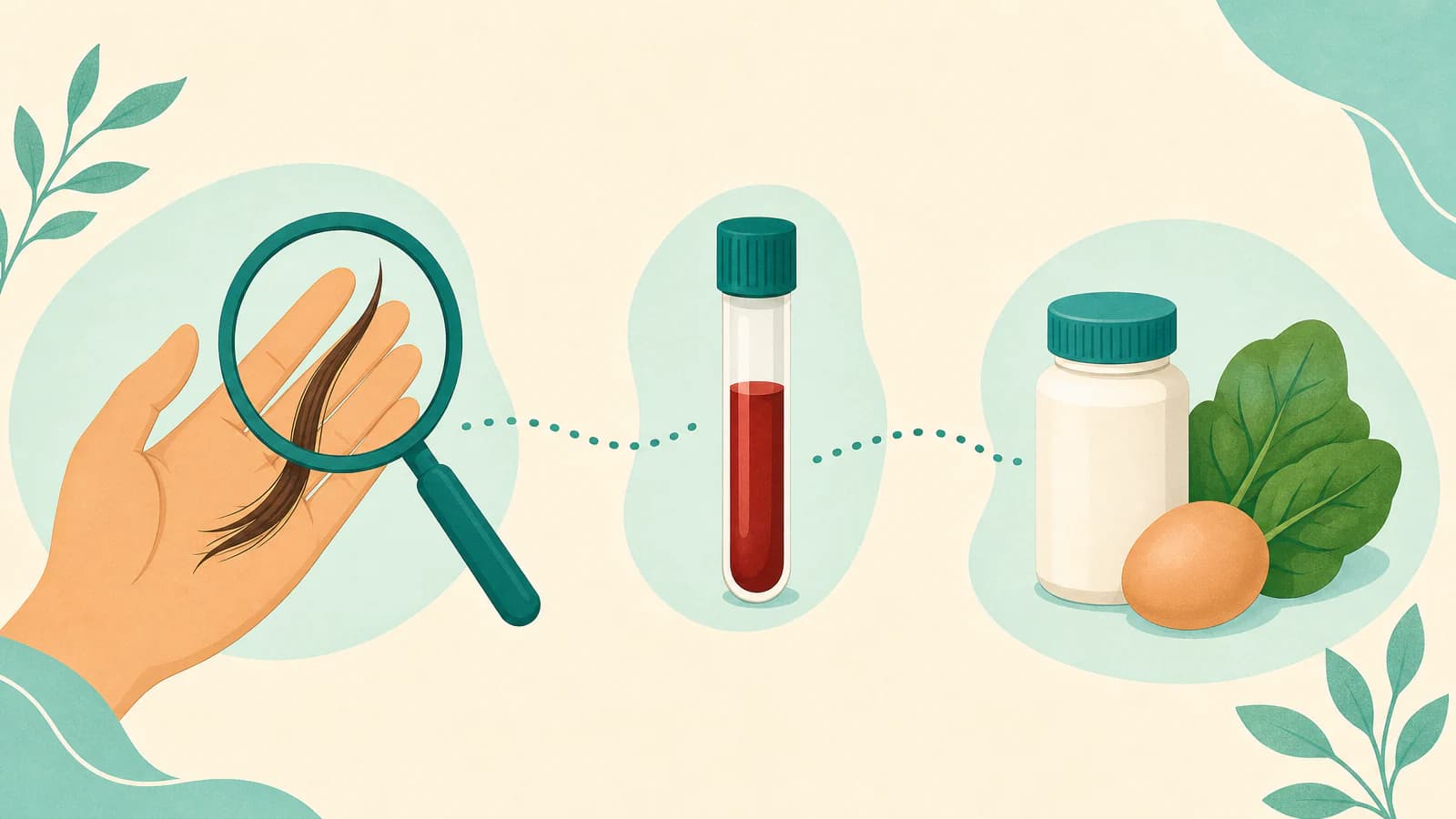
How it works: sign, nutrient, action
| What you notice | Nutrient worth checking | Read next |
|---|---|---|
| Heavy shedding a few months after fast weight loss or starting a GLP-1 drug | Protein, iron, vitamin D, B12, zinc | Supplements for hair loss on GLP-1 |
| A rash around the mouth, easy bruising, darker knuckles, pale itchy skin | Zinc, vitamin C, B12, iron, niacin | Vitamin deficiency skin symptoms |
| Brittle, peeling, splitting nails | Iron, biotin (maybe), protein | Vitamins for nails |
| Thinning hair and a biotin bottle in your cart | Biotin (rarely low) | Biotin for hair: does it work? |
| Red, inflamed acne | Zinc, omega-3, vitamin D | Supplements for acne |
The five guides
Supplements for hair loss on GLP-1 drugs. Shedding on Ozempic, Wegovy, Mounjaro or Zepbound is usually temporary. This guide ranks what to take: protein first, a basic multivitamin as a safety net, single nutrients only when a test shows a gap, and what to skip.
Vitamin deficiency skin symptoms. A sign-to-nutrient table for the skin: pellagra and niacin, scurvy and vitamin C, zinc rashes, B12 and darker skin, iron and itch, plus the truth about peeling fingertips.
Vitamins for nails. Why most brittle nails are a water problem, what the biotin studies actually found, why iron is the one to test, and the habits that help more than any pill.
Biotin for hair: does it work? The evidence (thin), the doses on labels (huge), and the FDA warning about lab tests, including troponin, that every biotin user should know.
Supplements for acne. Zinc has the best evidence, and it is modest. Safe doses, the antibiotic timing rule, what Reddit gets right, and when a dermatologist is the better move.
Who should test before buying anything
A blood test is worth it before you spend money if you:
- Take a GLP-1 drug or have had weight-loss surgery
- Eat a very restricted diet (very low calorie, or vegan without a B12 source)
- Have heavy periods, are pregnant or are breastfeeding
- Take long-term medicines such as metformin, acid reducers or anticonvulsants
- Have a digestive condition that affects absorption
Labs to ask for: ferritin and a complete blood count, vitamin D, B12, zinc and thyroid (TSH). If you take biotin in any product, tell the lab first.
Always talk to your doctor before starting a supplement, especially if you are pregnant, breastfeeding, take other medicines, or have kidney or liver disease.
How we judge a supplement
The FDA does not approve dietary supplements before they are marketed, and it generally does not approve their claims either. So we use a short checklist before we point to any product:
- Third-party tested. A USP Verified or NSF Certified seal.
- A sensible dose. Close to the Daily Value, under the NIH upper limit where one exists.
- A clear label. One clear ingredient list, not a proprietary blend that hides doses.
- Honest wording. "Supports" a normal function, never a promise to fix a disease.
- A lab test warning on anything with high-dose biotin.
We never present a supplement as a treatment. When we earn money from a product, the card says so.
What supplements cannot do
- Stop pattern hair loss. A receding hairline or thinning crown needs a dermatologist.
- Replace acne treatment. For moderate or severe acne, prescription options work better.
- Make healthy nails grow faster. Nails grow at their own pace once nothing is missing.
- Fix a rash that is not caused by a deficiency. Most rashes are eczema, irritation or infection.
Not sure what is low? Check the signs first
- Hair: shedding or real thinning? Check your hair signs, or read about telogen effluvium.
- Nails: check your nail signs, or see what your nails say about vitamin deficiency.
- Skin: if it is a rash rather than a deficiency, browse rashes and skin conditions or compare yours with the rash photo check.
Frequently asked questions
Do hair, skin and nail vitamins work?+
They help when they fill a real gap, such as low iron, protein or zinc. In people with normal levels, the evidence that they improve hair, skin or nails is weak. Test first, then supplement what is low.
Which vitamin deficiency causes hair loss?+
Iron deficiency is the best-known link, and low protein intake is a classic trigger for shedding. Vitamin D, zinc and, rarely, biotin are also checked. A thyroid problem can cause shedding too, so ask for a TSH test.
What blood tests should I ask for before taking supplements for hair, skin or nails?+
Ferritin and a complete blood count, vitamin D, vitamin B12, zinc and thyroid (TSH) cover the common causes. Your doctor may add others based on your symptoms.
Are supplements approved by the FDA?+
No. Under the Dietary Supplement Health and Education Act, the FDA does not approve dietary supplements before they are marketed. Look for a USP Verified or NSF Certified seal for quality.
Is biotin worth taking for hair and nails?+
Only for a true deficiency, which is rare. For brittle nails there are two small, older studies. High doses can make lab tests falsely high or low, including troponin, so tell your doctor and the lab if you take it.
Who should talk to a doctor before taking supplements?+
Everyone benefits from a quick check, and it matters most if you are pregnant or breastfeeding, take prescription medicines, have kidney or liver disease, or are on a GLP-1 drug or have had weight-loss surgery.
Sources
- U.S. Food and Drug Administration. Questions and answers on dietary supplements. Accessed 2026. fda.gov
- NIH Office of Dietary Supplements. Dietary supplement fact sheets (upper intake levels). Accessed 2026. ods.od.nih.gov
- Almohanna HM, Ahmed AA, Tsatalis JP, Tosti A. The role of vitamins and minerals in hair loss: a review. Dermatology and Therapy. 2019. PubMed
- Galimberti F, Mesinkovska NA. Skin findings associated with nutritional deficiencies. Cleveland Clinic Journal of Medicine. 2016. PubMed
- Patel DP, Swink SM, Castelo-Soccio L. A review of the use of biotin for hair loss. Skin Appendage Disorders. 2017. PubMed
- Yee BE, Richards P, Sui JY, Marsch AF. Serum zinc levels and efficacy of zinc treatment in acne vulgaris: a systematic review and meta-analysis. Dermatologic Therapy. 2020. PubMed
- Mozaffarian D, Agarwal M, Aggarwal M, et al. Nutritional priorities to support GLP-1 therapy for obesity: a joint Advisory. American Journal of Clinical Nutrition. 2025. PubMed
This article is for general education and is not medical advice. It does not replace a consultation with a qualified clinician. If a symptom worries you, see a doctor.