You have read the threads. "Zinc cleared my skin." A before and after that looks like two different people. Now you are wondering whether it is real, and how to try it without feeling sick.
Here is what the studies show, what the Reddit posts get right, and where a supplement fits next to real acne treatment.
The short answer
Zinc has the best evidence of any acne supplement, but it is modest. It helps mainly with red, inflamed bumps, and in a head-to-head trial it worked for about half as many people as a standard antibiotic. Omega-3 and vitamin D have small studies; probiotics are early. For moderate or severe acne, prescription treatment works better, and a dermatologist is the fastest route there.
- •Zinc has the best evidence of any acne supplement. It helps mainly with red, inflamed bumps, and the effect is modest.
- •In a head-to-head trial, 30 mg of zinc a day worked for about half as many people as the antibiotic minocycline.
- •Stay at or under 40 mg of zinc a day from all sources, take it with food, and space it from doxycycline or minocycline.
- •Omega-3, vitamin D and probiotics have small, early studies. Vitamin D makes sense only if you are low.
- •For moderate or severe acne, prescription treatment works better. See a dermatologist for deep, painful or scarring acne.

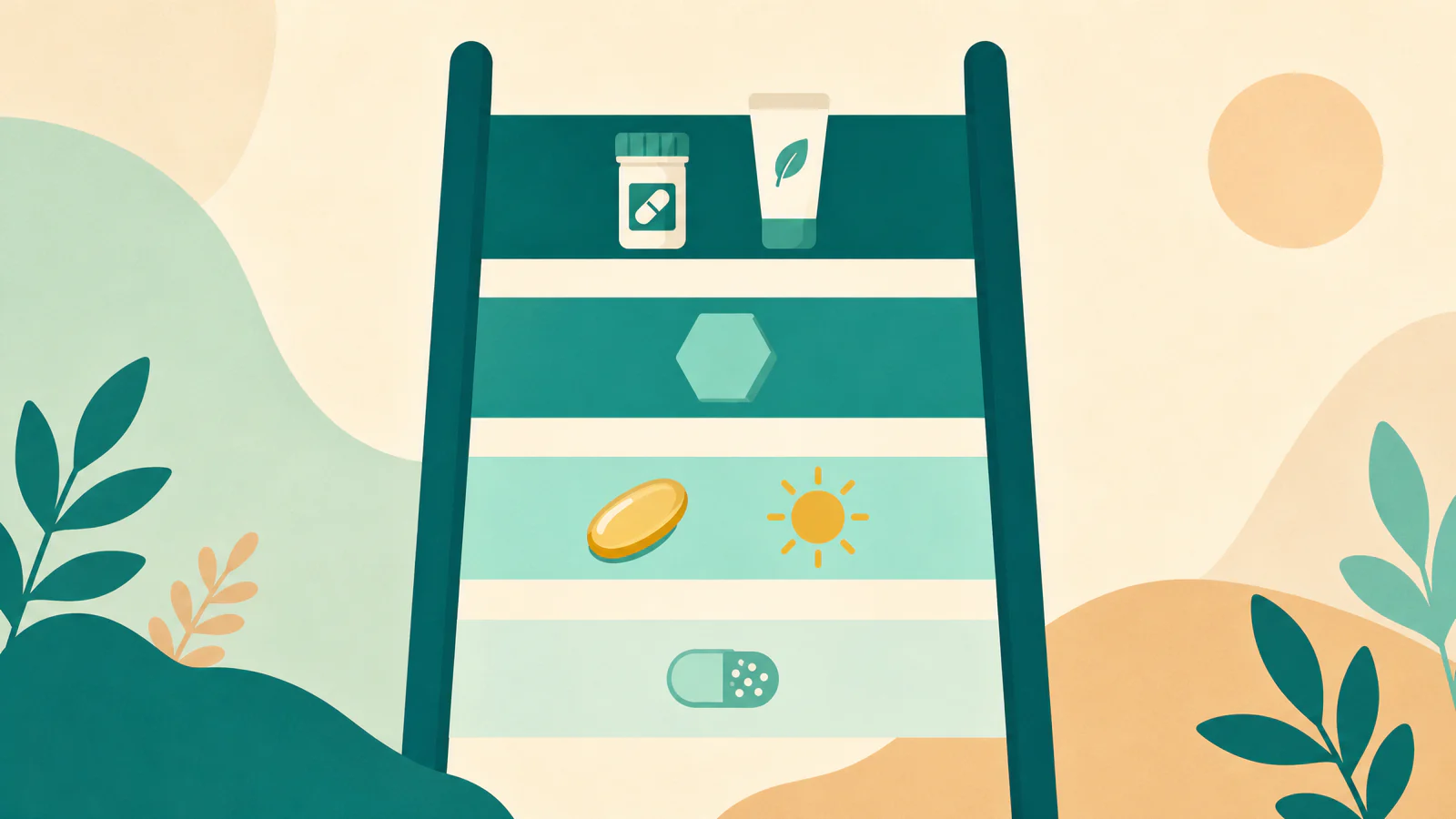
Zinc for acne: what the studies show
People with acne tend to run lower in zinc. A 2020 systematic review and meta-analysis found lower average blood zinc in people with acne than in people without it. In the treatment studies it pooled, zinc reduced inflammatory papules (the red, tender bumps), and side effects were no more common than with the comparison treatments.
Zinc lost the head-to-head. The biggest trial (332 people) compared 30 mg of elemental zinc a day, as zinc gluconate, with 100 mg of the antibiotic minocycline for three months. Success, defined as at least a two-thirds drop in inflamed spots, came for:
| Treatment | People who reached the success mark |
|---|---|
| Zinc gluconate, 30 mg elemental zinc a day | 31.2% |
| Minocycline, 100 mg a day | 63.4% |
In plain terms: zinc helped some people, and the antibiotic helped about twice as many. Side effects in both groups were mostly stomach-related.
Why people still try it. A 2018 review points to zinc's low cost and lack of systemic side effects compared with some acne medicines. That makes it a reasonable add-on for mild inflamed acne, or an option to discuss with your doctor if antibiotics are not right for you.
Zinc for acne on Reddit: what the before and after posts get right and wrong
What they get right:
- Some people do see fewer red bumps. That matches the studies.
- It takes time. The main trial judged results at three months, not three weeks.
- Nausea is real. Taking zinc on an empty stomach is the most common complaint, and the trials saw mostly stomach side effects too.
What they get wrong:
- A before and after cannot isolate zinc. Acne naturally flares and calms. Most people who post a transformation also changed their cleanser, started a retinoid or simply waited out a bad month.
- More is not better. Posts that stack 50 mg or more a day for months risk low copper (more below).
- Zinc is not a substitute for treatment when acne is deep, painful or scarring.
We do not show before and after photos on this page. A single pair of photos cannot tell you what caused the change.
How to take zinc safely
| Point | What to know |
|---|---|
| Dose | The main acne trial used 30 mg of elemental zinc a day. The adult upper limit is 40 mg a day from all sources, including your multivitamin (NIH). |
| Elemental zinc | Compare products by the elemental zinc listed on the Supplement Facts panel, not the weight of the whole compound. |
| Form | Zinc gluconate is the form used in the largest trial. |
| Food | Take it with a meal. Nausea and vomiting are the classic side effects on an empty stomach. |
| Copper | Taking 50 mg or more a day for weeks can lower copper levels and affect immune function (NIH). |
| Antibiotics | Zinc can block tetracyclines (doxycycline, minocycline) and quinolones. Take the antibiotic at least 2 hours before or 4 to 6 hours after zinc (NIH). |
| Time | Give it about three months before you judge it. |
Talk to your doctor or dermatologist before starting zinc, especially if you take antibiotics or other medicines, are pregnant or breastfeeding, or have kidney or liver disease.
Omega-3: promising, small
A 10-week randomized trial in 45 people with mild to moderate acne compared 2,000 mg a day of EPA plus DHA (the omega-3s in fish oil), 400 mg a day of gamma-linolenic acid from borage oil, and no supplement. Both supplement groups had fewer inflamed and non-inflamed lesions, and skin samples showed less inflammation. One small trial is a start, not proof. Fish oil can interact with blood thinners, so ask your doctor first if you take one.
Vitamin D: only if you are low
In one study, vitamin D deficiency was found in 48.8% of people with acne versus 22.5% of people without it, and lower levels went with more inflamed acne. When 39 deficient patients took 1,000 IU a day for two months, their inflamed lesions improved. That points to testing, not to taking vitamin D on spec. The adult upper limit is 4,000 IU a day.
Probiotics: too early to call
A pilot study gave 20 adults with acne either a probiotic drink (Lactobacillus rhamnosus SP1) or a placebo for 12 weeks and saw improvement in the probiotic group. Twenty people is too few to recommend a product, and results from one strain do not carry over to others.
What not to expect, and what to avoid
- Supplements do not replace treatment. They will not do what benzoyl peroxide, a retinoid or a prescription can do for moderate or severe acne.
- No vitamin A pills with isotretinoin or other retinoid pills. Taking them together can push vitamin A to harmful levels (NIH).
- Watch high-dose B12. Acne is a reported skin side effect of B12 therapy, according to a dermatology review.
- Skip biotin megadoses. They do nothing for acne and can throw off blood tests, including troponin. See biotin for hair.
What works better for most acne
The American Academy of Dermatology's 2024 guideline gives its strongest recommendations to benzoyl peroxide, topical retinoids, topical antibiotics and oral doxycycline. Isotretinoin is strongly recommended for severe acne, acne that scars or causes real distress, and acne that has not responded to other treatment. Hormonal options such as combined birth control pills and spironolactone are also on the list for the right person.
See a dermatologist if you have:
- Deep, painful pimples or cysts
- Acne that leaves scars or dark marks
- No improvement after several weeks of store-bought treatment
- Acne that affects how you feel about yourself
Not sure it is acne?
Some bumps that look like acne are something else: a rash around the mouth, irritated hair follicles, or a reaction to a product. If your "acne" does not behave like acne, compare it with common rashes before you buy anything. If you suspect a deeper gap, check vitamin deficiency skin symptoms.
 Not sure it is acne? Add a photo of the bumpsAI describes what it sees, which common rashes it looks like, and when to see a doctor. It does not diagnose. One check is $4.99.Add a photo
Frequently asked questions
Does zinc help acne?+
It can, modestly. A 2020 meta-analysis found that people with acne had lower blood zinc than people without, and that zinc reduced inflamed bumps. In a head-to-head trial, though, zinc worked for about half as many people as the antibiotic minocycline.
How much zinc should I take for acne?+
The large acne trial used 30 mg of elemental zinc a day, as zinc gluconate. The adult upper limit is 40 mg a day from all sources, including any multivitamin. Talk to your doctor before going higher.
How long does zinc take to work for acne?+
Give it about three months. The main zinc trial measured results at 90 days, and acne naturally comes and goes, so a few weeks is too short to judge.
Can I take zinc with doxycycline or minocycline?+
Yes, but not at the same time. Zinc can block absorption of tetracycline antibiotics. The NIH advises taking the antibiotic at least 2 hours before or 4 to 6 hours after the zinc supplement.
Which form of zinc is best for acne?+
Zinc gluconate is the form used in the largest acne trial, which makes it the best-studied choice. Whatever the form, compare products by elemental zinc, the amount listed on the Supplement Facts panel.
Does fish oil help acne?+
Possibly a little. One 10-week trial in 45 people with mild to moderate acne found fewer lesions with 2,000 mg of EPA and DHA a day. It is a single small study, and fish oil can interact with blood thinners.
When should I see a dermatologist for acne?+
If you have deep, painful pimples or cysts, acne that leaves scars, acne that has not improved after several weeks of store-bought treatment, or acne that affects how you feel. Prescription treatments work better for moderate and severe acne.
Related
- Supplements for skin, hair and nails: what the evidence says
- Vitamin deficiency skin symptoms: what each sign points to
- Biotin for hair: does it work?
Sources
- Yee BE, Richards P, Sui JY, Marsch AF. Serum zinc levels and efficacy of zinc treatment in acne vulgaris: a systematic review and meta-analysis. Dermatologic Therapy. 2020. PubMed
- Dreno B, Moyse D, Alirezai M, et al. Multicenter randomized comparative double-blind controlled clinical trial of the safety and efficacy of zinc gluconate versus minocycline hydrochloride in the treatment of inflammatory acne vulgaris. Dermatology. 2001. PubMed
- Cervantes J, Eber AE, Perper M, et al. The role of zinc in the treatment of acne: a review of the literature. Dermatologic Therapy. 2018. PubMed
- Jung JY, Kwon HH, Hong JS, et al. Effect of dietary supplementation with omega-3 fatty acid and gamma-linolenic acid on acne vulgaris: a randomised, double-blind, controlled trial. Acta Dermato-Venereologica. 2014. PubMed
- Lim SK, Ha JM, Lee YH, et al. Comparison of vitamin D levels in patients with and without acne: a case-control study combined with a randomized controlled trial. PLoS One. 2016. PubMed
- Fabbrocini G, Bertona M, Picazo Ó, et al. Supplementation with Lactobacillus rhamnosus SP1 normalises skin expression of genes implicated in insulin signalling and improves adult acne. Beneficial Microbes. 2016. PubMed
- Reynolds RV, Yeung H, Cheng CE, et al. Guidelines of care for the management of acne vulgaris. Journal of the American Academy of Dermatology. 2024. PubMed
- Brescoll J, Daveluy S. A review of vitamin B12 in dermatology. American Journal of Clinical Dermatology. 2015. PubMed
- American Academy of Dermatology. Treating acne? Is it time to see a dermatologist? Accessed 2026. aad.org
- NIH Office of Dietary Supplements. Zinc: fact sheet for health professionals. Accessed 2026. ods.od.nih.gov
- NIH Office of Dietary Supplements. Vitamin A and carotenoids: fact sheet for health professionals. Accessed 2026. ods.od.nih.gov
This article is for general education and is not medical advice. It does not replace a consultation with a qualified clinician. If a symptom worries you, see a doctor.