You shaved, waxed or just sweated through a workout, and now there are red, pimple-like bumps right where the hair grows. Folliculitis or ingrown hair?
This page shows what each tends to look like, the one clue that separates them (look for the hair), what helps, and the mistakes that turn a small bump into a scar.
Quick answer: An ingrown hair is usually one bump, or a few, where hair was shaved, waxed or plucked, and sometimes you can see the hair as a loop or dark line under the skin. Folliculitis is usually a crop of similar small, pimple-like bumps, each centered on a hair, and it can spread beyond the shaved area. They overlap: an ingrown hair that gets infected can look like folliculitis. Do not pop or dig at either.
Bumps where you shave or wax and can't tell folliculitis from ingrown hairs? Add a photo and the AI photo check compares what it sees with both descriptions.
 Still not sure? Folliculitis or ingrown hairs?Tap to add a photo of the rash on your thighAI describes what it sees, which common rashes it looks like, and when to see a doctor. It does not diagnose. One check is $4.99.Add a photo
Folliculitis vs ingrown hair at a glance
| Folliculitis | Ingrown hair | |
|---|---|---|
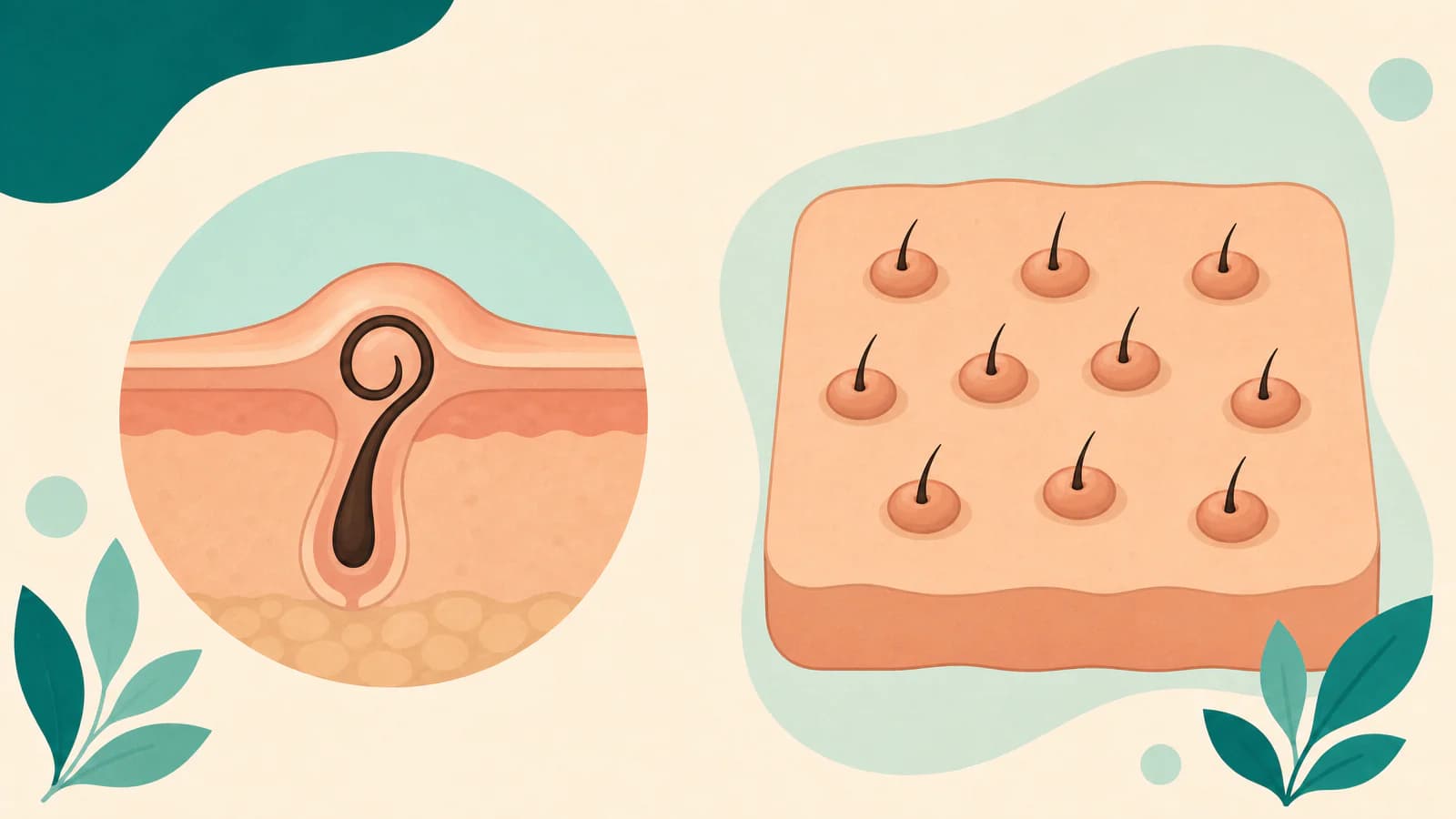
| Looks like | A crop of small red or darker bumps or white-headed pustules, each around a hair follicle, often similar in size | One bump or a few, sometimes with a hair visible as a loop or dark line under the skin. Sizes vary |
| Where on the body | Beard area, thighs, buttocks, armpits, chest, back, groin, anywhere with hair. Also under a swimsuit or tight clothes | Where hair is shaved, waxed or plucked: face and neck, legs, armpits, bikini line, chest |
| Itch or pain | Itchy, tender or burning | Itchy or sore, sometimes painful when infected |
| Pattern and spread | Appears in crops. Can spread past the shaved area | Lines up with where the hair was removed. May leave a dark mark after healing |
| Contagious? | Not usually, but shared razors and towels can pass bacteria. Hot tub types come from the water | No |
| Typical trigger | Friction, tight or sweaty clothing, shaving, bacteria, hot tubs, yeast, oily or occlusive products | Shaving, waxing or plucking, especially with coarse or curly hair |
| What usually helps | Warm compresses, keeping the area clean and dry, loose clothing | Letting the hair grow out, warm compress, no shaving or picking |
Is there a hair trapped in there, or just a pimple-like bump? Hard to see on your own skin, so add a photo and see the bumps next to both columns.
Still not sure? Folliculitis or ingrown hairs?Tap to add a photo of the rash on your thighAI describes what it sees, which common rashes it looks like, and when to see a doctor. It does not diagnose. One check is $4.99.Add a photo
What folliculitis looks like
Folliculitis is inflammation of the hair follicles. It shows up as small red bumps, or white-headed pustules that look like pimples, each centered on a hair, and you often see many at once, all roughly the same size. On brown and Black skin the bumps can look darker brown or purple rather than red. They can be itchy, tender or burning.
It happens anywhere there is hair: the beard area, thighs, buttocks, armpits, chest, back and groin. The usual causes are friction and tight clothing, sweat, shaving, and bacteria (often Staphylococcus). Thick or oily creams can block follicles and make it worse.
Two variants are worth knowing. Hot tub folliculitis tends to appear a day or two after time in a hot tub or pool, mostly where a swimsuit covered the skin. Yeast folliculitis (Malassezia) tends to look like itchy, uniform small bumps on the chest, back and shoulders, and it does not respond to antibacterial care.
Mild cases often settle in days to a couple of weeks once the cause is removed. Deeper infections form firm, painful lumps called boils.
What an ingrown hair looks like
An ingrown hair is a hair that curls back and grows into the skin, or never breaks through. It makes a raised, itchy or tender bump, red on light skin and darker or a different color on brown and Black skin. Sometimes you can see the hair trapped under the skin as a dark line or a small loop.
It happens where hair is shaved, waxed or plucked, and it is more common with coarse, curly or coiled hair: the face and neck, legs, armpits, chest, back and bikini line. In the beard area, repeat ingrown hairs are called razor bumps (pseudofolliculitis barbae).
Ingrown hairs often leave dark marks after they heal, which can last longer than the bump, especially on brown and Black skin. And an ingrown hair that gets infected can look just like folliculitis.
How to tell them apart at home
Look for the hair. A visible loop or dark line trapped under one bump points toward an ingrown hair. A hair growing straight out of the middle of each bump points toward folliculitis.
Count the bumps. One or a few, in different sizes, lean ingrown hair. A crop of similar small bumps leans folliculitis.
Check the map. Bumps exactly where you removed hair lean ingrown hair. Bumps that spread beyond that area, under a swimsuit or along tight waistbands, lean folliculitis.
Think about the timeline. A few days after shaving or waxing leans ingrown hair. A day or two after a hot tub, gym session or sweaty day in tight clothing leans folliculitis.
Look at the head. A white or yellow pimple-like head on every bump leans folliculitis.
Check if it is deep. A single large, painful, firm lump is more than either one. See the doctor section below.
Because they overlap, the care is similar either way: gentle, no picking, no shaving over it.
What helps each, and when it backfires
Talk to a doctor or pharmacist before you start anything, especially in pregnancy, while breastfeeding, if you take other medicines, for babies and young children, or with kidney or liver disease.
For ingrown hairs:
- Stop shaving, waxing and plucking the area for a while so the hairs grow out. The NHS notes that not shaving is the best prevention.
- A warm compress to soften the skin.
- Gentle cleaning with a soft washcloth.
- If the tip of the hair is visible, you can gently lift it free with a clean tool. Do not dig.
- If you shave: wet the skin first, use a sharp single blade, shave with the direction of growth and do not pull the skin tight or shave too close.
- Stubborn razor bumps have prescription options.
For folliculitis:
- Warm compresses a few times a day.
- Keep the area clean and dry, and wear loose, breathable clothing.
- Change out of sweaty clothes and wet swimsuits promptly.
- Do not share razors or towels.
- A pharmacist can suggest an over-the-counter antibacterial wash for mild cases. Persistent or yeast-type folliculitis needs a doctor.
Where it backfires:
- Popping or squeezing. It spreads infection and can scar.
- Digging with tweezers or a needle. It tears skin and invites infection.
- Shaving right over the bumps. It irritates the follicles and creates new ingrowns.
- Heavy, oily creams. They can block follicles.
- Tight clothing over the area. Friction keeps it going.
- Waxing or laser during an active infection. Wait until it settles.
When to see a doctor
- Bumps that keep coming back, or do not improve after a couple of weeks of gentle care.
- A deep, painful, firm lump or a boil.
- Spreading redness, warmth, swelling or a fever.
- Large or numerous bumps on the face or in the groin.
- Scarring or dark marks that bother you.
- Diabetes or a weak immune system.
Bumps keep coming back and you don't know why? Upload a photo before you pick or shave over them. It is a comparison, not a diagnosis.
Still not sure? Folliculitis or ingrown hairs?Tap to add a photo of the rash on your thighAI describes what it sees, which common rashes it looks like, and when to see a doctor. It does not diagnose. One check is $4.99.Add a photo
Related skin guides
- Heat rash vs hives, if the bumps are tiny and appeared after sweating.
- Eczema vs ringworm, if the skin patch is scaly rather than bumpy.
- The full skin rash guide.
Frequently asked questions
Is it folliculitis or an ingrown hair?+
Look for the hair. A hair trapped as a loop or dark line under one bump points toward an ingrown hair. A crop of similar pimple-like bumps, each with a hair coming out of the middle, points toward folliculitis. They can overlap, and an infected ingrown hair can look like folliculitis.
Can I pop an ingrown hair?+
It is better not to. Squeezing can spread infection and cause scarring. A warm compress and time usually work. If the hair tip is visible, you can gently lift it with a clean tool, but do not dig.
How long do ingrown hairs take to go away?+
Many settle within days to a couple of weeks if you stop shaving the area and keep it clean. If a bump is painful, growing or not improving, see a doctor.
Why do I keep getting ingrown hairs on my bikini line or beard?+
Shaving, waxing and plucking, especially close shaving, can make hair grow back into the skin, and coarse, curly hair is more prone. Letting hairs grow out, shaving with the direction of growth and using a sharp single blade can help.
Is folliculitis contagious?+
It usually is not passed from person to person, but sharing razors and towels can spread bacteria, and hot tub folliculitis comes from contaminated water.
Can I shave over folliculitis?+
It is best to avoid it until the bumps settle. Shaving over inflamed follicles irritates them and can spread bacteria.
How do I tell razor bumps from folliculitis?+
Razor bumps are ingrown hairs in the beard area, and they usually follow shaving, with a hair curled under the skin. Folliculitis forms a crop of similar bumps that can spread past the shaved area. They overlap, and a doctor can help if it keeps coming back.
Do ingrown hairs leave dark marks?+
They can, especially on brown and Black skin. The dark mark often lasts longer than the bump and fades gradually.
Sources
- Winters RD, Mitchell M. Folliculitis. StatPearls Publishing. 2023. PubMed 31613534
- National Health Service (UK). Ingrown hairs. nhs.uk, accessed October 2026. Link
- Dalia Y, Khatib J, et al. Review of treatments for pseudofolliculitis barbae. Clin Exp Dermatol. 2023. PubMed 36840647
- Nussbaum D, Friedman A. Pseudofolliculitis barbae: a review of current treatment options. J Drugs Dermatol. 2019. PubMed 30909328
This article is for general education and is not medical advice. It does not replace a consultation with a qualified clinician. If a symptom worries you, see a doctor.