Red, scaly, itchy skin on your elbows or knees, and two names stuck in your head: psoriasis and eczema. They overlap more than most pictures suggest.
This page covers what each one tends to look like, where on the body it likes to sit, the clues you can check yourself, and the signs (nails, joints) that mean it is time to book a visit.
Quick answer: Psoriasis tends to make thick, sharply outlined plaques with silvery scale, often on the outside of the elbows and knees, the scalp and the lower back. Eczema tends to be drier and blurrier, very itchy, and settles into creases: the inside of the elbows, behind the knees. Pits in the nails, or joint pain with a rash, point toward psoriasis. Allergies since childhood point toward eczema. Some people have both.
Red, scaly and itchy on your elbows or knees, and can't tell psoriasis from eczema? Add a photo and the AI photo check compares the edge, scale and color with both descriptions.
 Still not sure? Psoriasis or eczema?Tap to add a photo of the rash on your elbowAI describes what it sees, which common rashes it looks like, and when to see a doctor. It does not diagnose. One check is $4.99.Add a photo
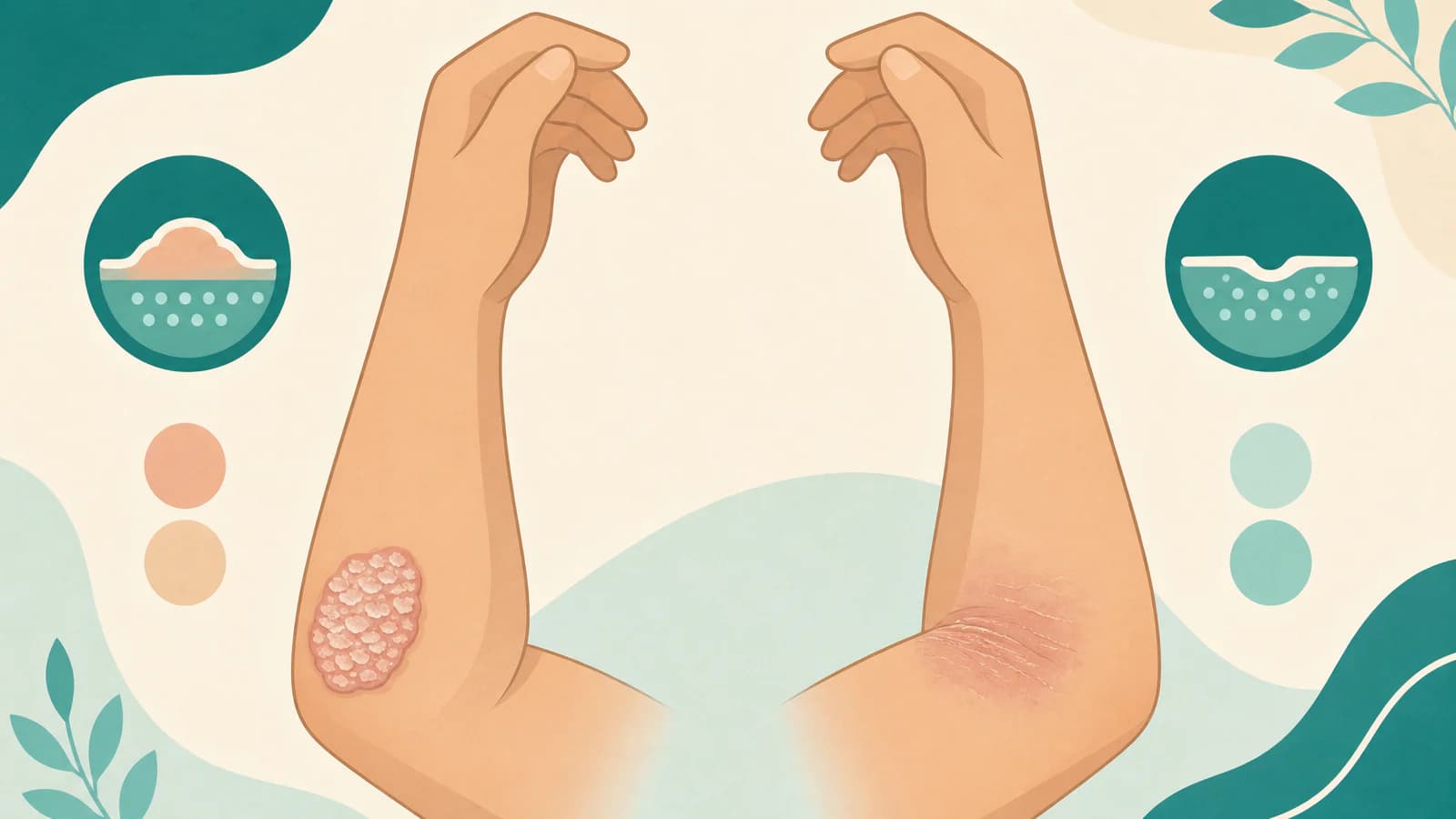
Psoriasis vs eczema at a glance
| Psoriasis | Eczema | |
|---|---|---|
| Looks like | Thick, raised, sharply outlined plaques topped with silvery-white scale | Dry, scaly patches with blurry edges that may ooze, crust or thicken from scratching |
| Where on the body | Outside of elbows and knees, scalp, lower back, buttocks, belly button, nails | Creases: inside of elbows, behind knees, neck, wrists, hands, eyelids |
| Itch or pain | Itch from mild to strong, often with burning or soreness. Cracks can bleed | Itch is the headline and is often worse at night |
| Pattern and spread | Plaques hold their shape. Flares come and go. New plaques can appear where skin is injured | Patches are vaguer and shift around. Flares with triggers, often since childhood |
| Contagious? | No | No |
| Typical trigger | Stress, strep throat, skin injury, some medicines, cold dry weather | Dry skin, harsh soap, scented products, allergens, sweat, stress |
| What usually helps | Moisturizer, scale-softening salicylic acid or coal tar products, short hydrocortisone, prescription options | Thick unscented moisturizer, avoiding triggers, short hydrocortisone, prescription options |
Is that scale thick and silvery, or just dry? It is hard to judge your own skin, so add a photo and see it next to both columns.
Still not sure? Psoriasis or eczema?Tap to add a photo of the rash on your elbowAI describes what it sees, which common rashes it looks like, and when to see a doctor. It does not diagnose. One check is $4.99.Add a photo
What psoriasis looks like
Plaque psoriasis, the common kind, makes raised, well-defined patches you could trace around with a pen. They are topped with a thick layer of silvery-white scale that flakes off in bits. On light skin the plaque underneath is pink or red. On brown and Black skin it often looks purple, dark brown or gray, and the scale can look gray or silvery.
The favorite spots are the outside of the elbows and knees, the scalp, the lower back, the buttocks and the belly button. Psoriasis can also reach the nails: tiny pits, crumbling, thickening, or a nail lifting off its bed. Eczema rarely does that.
The itch can be mild or strong, and many people describe burning, soreness or tightness more than itch. Dry plaques can crack and bleed.
It is driven by the immune system and runs in families. Flares can follow stress, a throat infection, an injury to the skin, certain medicines and cold, dry weather. It is not contagious.
Two variants worth knowing. Guttate psoriasis shows up as many small, drop-shaped spots, often after strep throat. Inverse psoriasis shows up as smooth, shiny, red or darker patches in skin folds such as the armpits, groin and under the breasts, with little scale.
Some people with psoriasis develop joint pain, stiffness or swelling (psoriatic arthritis). If a rash like this comes with achy, stiff or swollen joints, tell a doctor.
What eczema looks like
Eczema (atopic dermatitis) is dry, scaly and itchy, with edges that fade into the skin around it. On light skin it looks pink or red. On brown and Black skin it more often looks darker brown, purple or gray.
It tends to sit in the creases: inside of the elbows, behind the knees, neck, wrists, hands and eyelids, and on the cheeks and scalp in babies. The itch is the headline, often worse at night. Scratching can make skin ooze and crust, then thicken into darker, leathery patches.
Eczema usually starts in childhood and travels with asthma, hay fever or other allergies. It flares with dry skin, harsh soap, scented products, allergens, sweat and stress. It is not contagious. Round, coin-shaped patches are a separate story, covered in eczema vs ringworm.
How to tell them apart at home
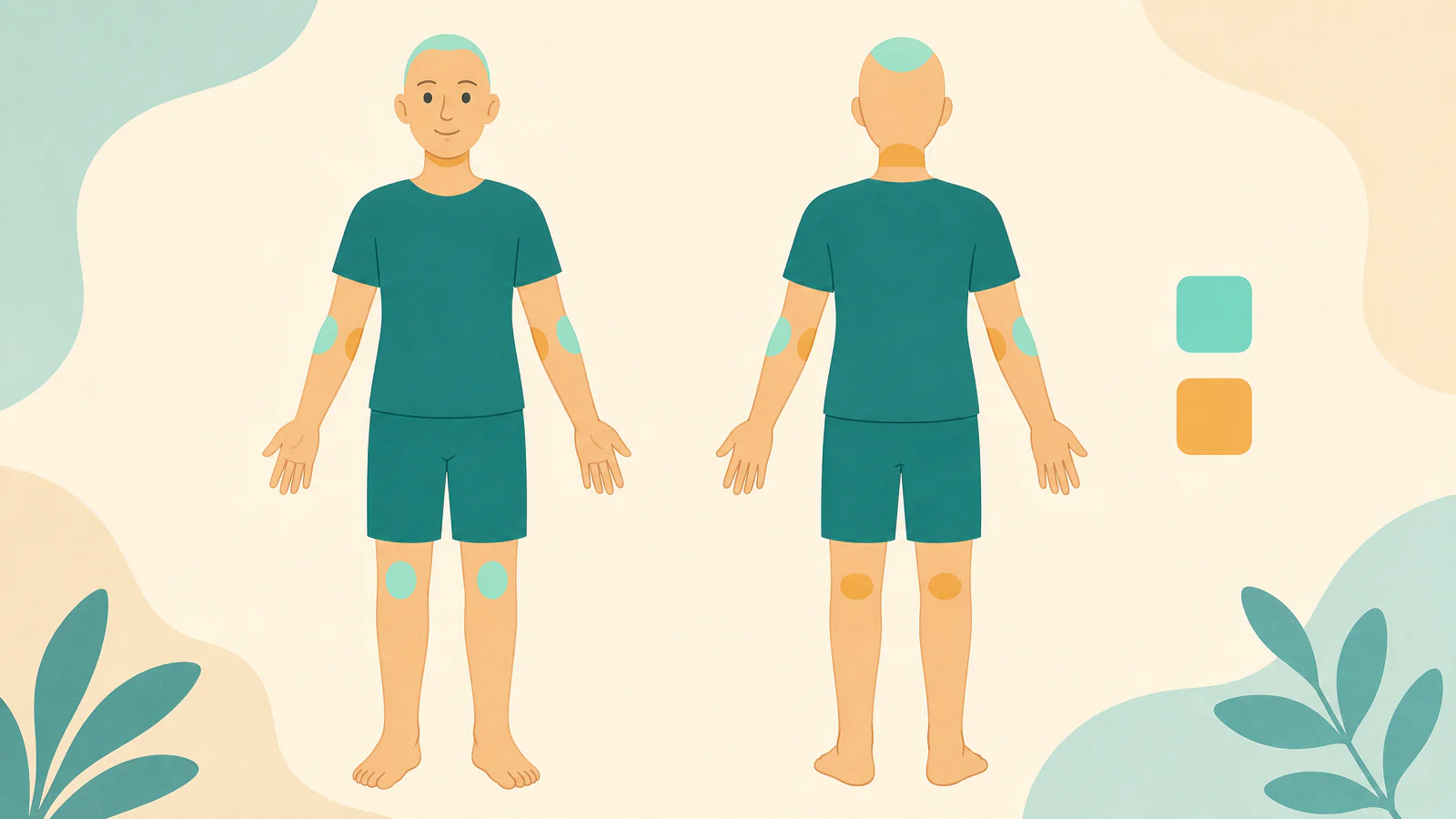
Find the location. Outside of the elbow or knee leans psoriasis. Inside of the elbow or behind the knee leans eczema. Neither rule is absolute.
Trace the edge. A crisp outline you can follow with a finger leans psoriasis. A border that fades out leans eczema.
Look at the scale. Thick, silvery, piled-up scale leans psoriasis. Fine, dry flakes on rough skin lean eczema.
Check your nails. Tiny pits, crumbling or lifting point toward psoriasis.
Ask what it feels like. Itch that dominates and wakes you at night leans eczema. Soreness, burning or tightness with moderate itch leans psoriasis.
Look at the history. Childhood eczema, hay fever or asthma lean eczema. A parent, sibling or child with psoriasis leans psoriasis.
Check other spots. Scalp, behind the ears, the belly button and the lower back are common psoriasis sites.
Some rashes sit squarely between the two, especially on the scalp, hands and skin folds. A doctor can usually tell by looking, and occasionally needs a small skin sample.
What helps each, and when it backfires
Talk to a doctor or pharmacist before you start anything, especially in pregnancy, while breastfeeding, if you take other medicines, for babies and young children, or with kidney or liver disease.
For psoriasis:
- Daily moisturizer, ideally a thick one, to cut cracking and soreness.
- Over-the-counter products with salicylic acid or coal tar soften and lift scale. Follow the label, expect stains and some sun sensitivity.
- Over-the-counter hydrocortisone only briefly and on small patches.
- Plaques that are widespread, thick or stubborn have good prescription options: stronger creams, vitamin D creams, light therapy, tablets or injections.
- A little sun often helps. Sunburn makes it worse.
For eczema:
- A thick, unscented cream or ointment daily, applied soon after a short lukewarm bath.
- Cutting back on triggers: harsh soap, scented products, hot showers.
- Over-the-counter hydrocortisone 1 percent for short courses on body flares.
Where it backfires:
- Picking or scrubbing off the scale. Injured skin can sprout new plaques in the same place.
- Salicylic acid or tar on eczema. It can sting and irritate cracked, inflamed skin.
- Strong steroid cream for long stretches. It can thin the skin. Use what a doctor prescribed, for as long as they said.
- Steroid tablets for a rash. Ask a doctor first, because stopping them can flare psoriasis.
- Long, hot baths. They dry out both.
When to see a doctor
- Joint pain, stiffness or swelling along with a rash, or a finger or toe that swells like a sausage.
- Nail changes: pits, lifting, crumbling or thickening.
- Patches covering a large part of the body, or most of the skin turning red and peeling. Get same-day care for that.
- Many small drop-shaped spots appearing after a sore throat.
- Involvement of the scalp, face or genitals.
- No improvement after a couple of weeks of moisturizer and a short over-the-counter course.
- Signs of infection: yellow crust, pus, increasing pain, warmth or fever.
- Itch, soreness or embarrassment that affects your sleep or mood.
Both columns sound a bit like you? That is common, and it is when a second look helps. Upload a photo for a comparison you can bring to an appointment, not a diagnosis.
Still not sure? Psoriasis or eczema?Tap to add a photo of the rash on your elbowAI describes what it sees, which common rashes it looks like, and when to see a doctor. It does not diagnose. One check is $4.99.Add a photo
Related skin guides
- Eczema vs ringworm, if your patch is round and you are wondering about a fungus.
- Scabies vs eczema, if the itch is worst at night and others at home itch too.
- Dandruff vs dry scalp and itchy scalp causes, if most of it is on the scalp.
- The full skin rash guide.
Frequently asked questions
Is it psoriasis or eczema? My elbows are red and scaly.+
Where on the elbow matters. Psoriasis tends to sit on the outside point of the elbow in thick, sharply outlined plaques with silvery scale. Eczema tends to sit in the inner crease with a blurrier edge. Nail pits or a family history of psoriasis point toward psoriasis, and a history of allergies toward eczema.
Can you have psoriasis and eczema at the same time?+
Yes, it is possible to have both, and some rashes show features of each. If your rash does not behave like either one, a doctor can examine it and sometimes take a small skin sample.
Does psoriasis itch?+
It can. The itch ranges from mild to strong, and many people feel burning, soreness or tightness as much as itch. Eczema is more often dominated by itch, especially at night.
Can eczema look silver and flaky?+
Eczema can be very scaly, but the scale is usually fine and dry on a blurry-edged patch. Thick, silvery, piled-up scale on a sharply outlined plaque points more toward psoriasis.
Is psoriasis contagious?+
No. You cannot catch it from touching someone, sharing towels or swimming in the same pool. It is driven by the immune system and runs in families.
Can stress make psoriasis or eczema worse?+
For many people, yes. Stress is a common trigger for flares of both, along with skin injury, infections and weather. Managing stress will not cure either one, but it can reduce flares for some.
Can a doctor tell just by looking?+
Often, yes. The location, outline, scale and nail changes give a lot away. When it is unclear, a doctor may take a small skin sample (a biopsy) to look at under a microscope.
Sources
- American Academy of Dermatology Association. Psoriasis: Overview. aad.org, accessed October 2026. Link
- American Academy of Dermatology Association. Eczema types: Atopic dermatitis overview. aad.org, accessed October 2026. Link
- National Health Service (UK). Psoriasis. nhs.uk, accessed October 2026. Link
- National Health Service (UK). Atopic eczema. nhs.uk, accessed October 2026. Link
- Armstrong AW, Read C. Pathophysiology, clinical presentation, and treatment of psoriasis: a review. JAMA. 2020. PubMed 32427307
- Nair PA, Badri T. Psoriasis. StatPearls Publishing. 2023. PubMed 28846344
- Kolb L, Villarreal LA, et al. Atopic dermatitis. StatPearls Publishing. 2026. PubMed 28846349
This article is for general education and is not medical advice. It does not replace a consultation with a qualified clinician. If a symptom worries you, see a doctor.