Almost every adult hairline moves back a little from where it sat in the teenage years, and that alone does not mean you are balding. The useful question is whether your hairline has shifted back and settled, which is normal, or whether it keeps creeping backward, which is the start of pattern loss.
Here is how to tell a mature hairline from a receding one, and the simplest test to know which you have. You can also track your hairline over months.
- •A mature hairline moves back about 0.5 to 2 cm in your twenties and then stabilizes, fairly even, with no real thinning.
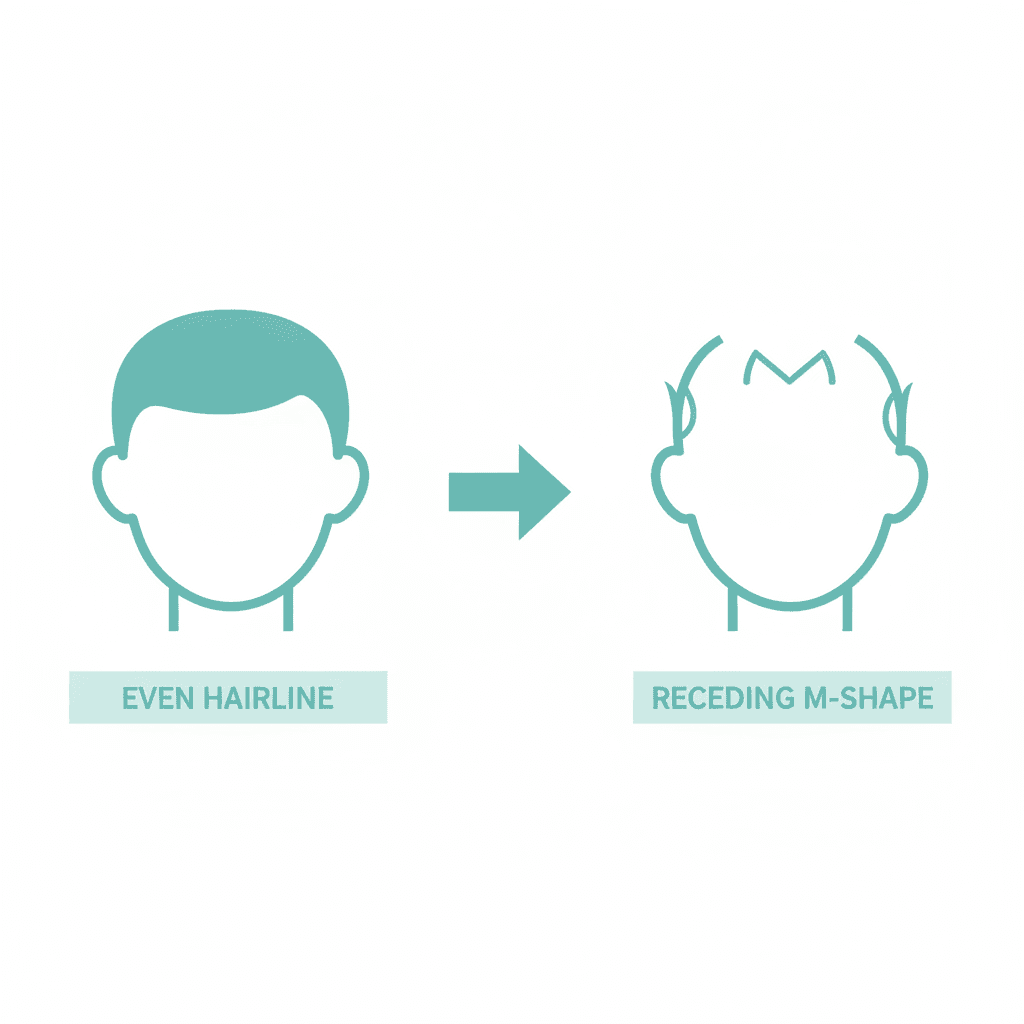
- •A receding hairline keeps progressing, usually unevenly into an M-shape at the temples, often with crown thinning.
- •Photos over six to twelve months are the clearest test; ongoing change is the cue to see a doctor early.
A mature hairline
As you leave your teens, the hairline usually rises by about half a centimetre to two centimetres and then stops. A mature hairline is fairly even across the forehead, holds its new position, and does not come with thinning behind it. It is a one-time shift, not an ongoing process, and most men go through it.
A receding hairline
A receding hairline does not settle. It keeps moving back, and it tends to do so unevenly, with the temples retreating faster than the middle to leave an M or V shape. It often arrives alongside thinning at the crown, and the hairs at the new edge get finer over time. This is the pattern of androgenetic hair loss.
How to tell them apart
A few checks separate the two:
- The finger test. A hairline that has risen roughly a finger's width from your teenage line and then held steady is usually mature.
- The shape. An even line suggests maturing. A deepening M-shape at the temples suggests receding.
- The company it keeps. Maturing happens alone. Receding often travels with crown thinning and increased shedding.
- Photos over time. This is the clearest test. Compare front-on photos in the same light six to twelve months apart. A mature hairline looks the same; a receding one has moved.
Patterns and stages
If it is receding, the Norwood scale maps where you sit and how it tends to progress, which helps you and a clinician judge whether to act. Pairing that with whether you are shedding or losing gives a clear picture.
When to see a doctor
See a doctor if:
- Your hairline keeps moving back over months rather than settling
- The temples are receding into an M-shape, especially with crown thinning
- Hairs at the edge are visibly finer than before
- You want to start treatment, which works best early
Frequently asked questions
How do I know if my hairline is maturing or receding?+
A mature hairline shifts back a little and then stays put, fairly even, with no thinning behind it. A receding hairline keeps moving, often unevenly at the temples, and tends to come with thinning.
At what age does a hairline mature?+
Most hairlines settle into their mature position in the late teens to early thirties, moving back roughly a finger's width from the teenage line.
Is a receding hairline always balding?+
Not always, but a hairline that keeps progressing into an M-shape, especially with crown thinning, is the pattern of androgenetic hair loss and is worth checking early.
Related
Sources
- American Academy of Dermatology, hair loss types and patterns
- Healthline, hair loss and hairline resources
This article is for general education and is not medical advice. It does not replace a consultation with a qualified clinician. If a symptom worries you, see a doctor.