If you have started reading about hair loss, you have met the Norwood scale, sometimes called the Hamilton-Norwood scale. It is the standard way doctors describe male pattern hair loss, sorting it into seven stages so that change can be tracked and treatment timed. Knowing roughly where you sit is genuinely useful, both for spotting progression and for talking to a clinician.
Here is what each stage looks like and how to use the scale without overthinking it. You can also track your hairline against it over time.
- •The Norwood scale grades male pattern hair loss in seven stages, from a mature hairline (1 to 2) to extensive loss (6 to 7).
- •It tracks two fronts that often meet over time: the hairline receding and the crown thinning.
- •Women's diffuse thinning is graded differently, on the Ludwig scale; use the scale to track change and time treatment, not to self-diagnose.
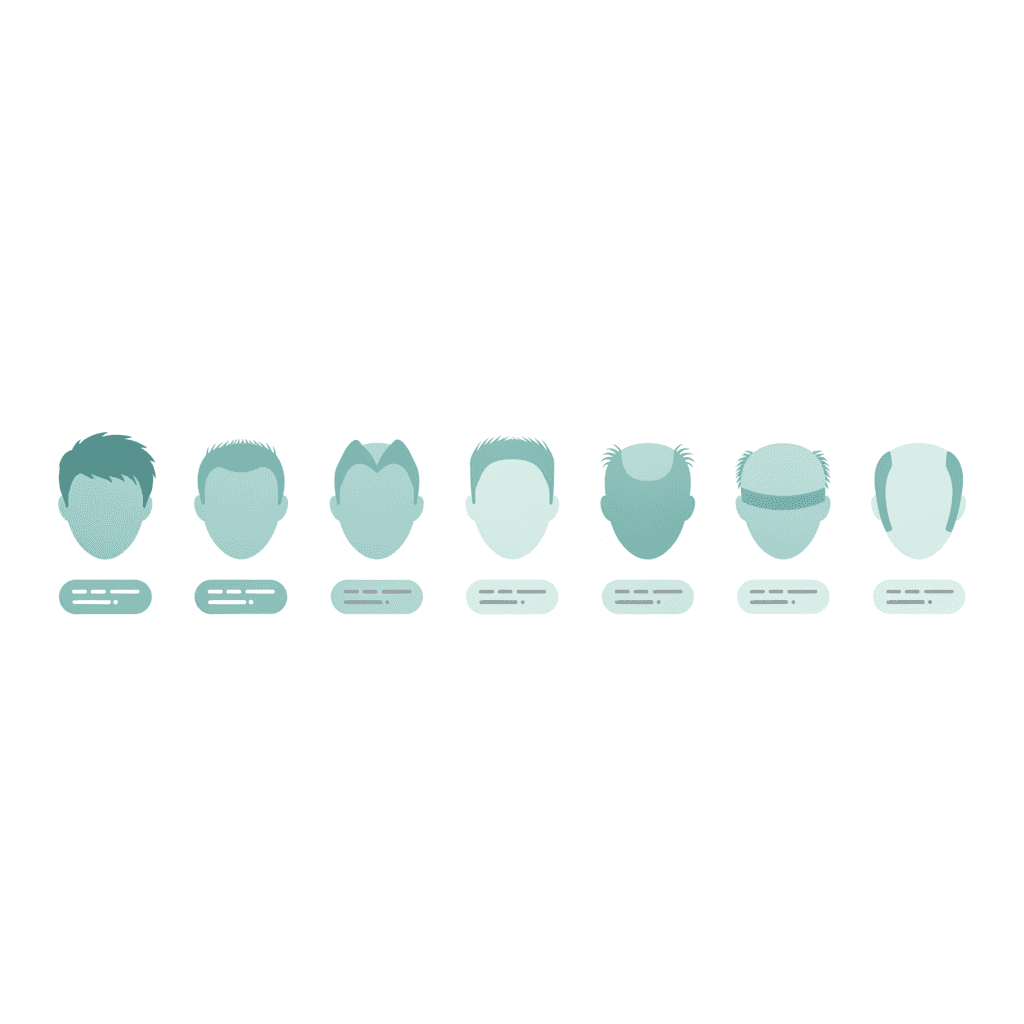
What the scale measures
Male pattern loss usually advances on two fronts: the hairline recedes from the front, and a thin patch opens at the crown. The Norwood scale captures how far each has gone, and how close they are to meeting. It says nothing about why it is happening, only how far along it is.
The seven stages
- Stage 1. A full, youthful hairline with no real recession.
- Stage 2. A mature hairline, shifted back slightly at the temples. This is normal and most men reach it.
- Stage 3. The first clearly balding stage, with deeper temple recession forming an M-shape. A 3-vertex variant adds early crown thinning.
- Stage 4. More temple recession plus a defined bald patch at the crown, separated by a band of hair.
- Stage 5. The band between hairline and crown narrows and thins as the two areas grow toward each other.
- Stage 6. The bridge of hair largely goes, joining the front and crown loss.
- Stage 7. The most advanced stage, leaving only a horseshoe of hair around the sides and back.
The Ludwig scale for women
Female pattern loss usually looks different, a diffuse thinning over the top of the scalp and a widening part rather than a receding hairline. That is graded on the Ludwig scale instead, in three broad grades of increasing thinning.
How to use it
Treat the scale as a tracker, not a verdict. Take front and crown photos in the same light every few months and compare them to the stages. Movement between stages is the signal that matters, and it is the cue to see a dermatologist, since treatment holds onto far more hair when it starts early.
When to see a doctor
See a doctor if you are past a mature hairline and progressing, if the crown is thinning, or if you want to start treatment. Early action is the single biggest lever you have.
Frequently asked questions
What are the stages of the Norwood scale?+
Seven. Stages 1 to 2 are a youthful then mature hairline, 3 marks the first real recession, 3-vertex and 4 to 5 add crown thinning, and 6 to 7 are extensive loss leaving a horseshoe of hair.
Is there a Norwood scale for women?+
Women's pattern loss is usually diffuse thinning over the top rather than a receding hairline, so it is graded on the Ludwig scale instead.
How do I know what Norwood stage I am?+
Compare your hairline and crown to the stages, ideally with photos over time. For anything beyond a mature hairline, a dermatologist can grade it accurately and advise on treatment.
Related
Sources
- American Academy of Dermatology, male pattern hair loss
- Healthline, Norwood scale resources
This article is for general education and is not medical advice. It does not replace a consultation with a qualified clinician. If a symptom worries you, see a doctor.