The crown is the spot people discover last, usually from an unflattering photo or a comment from behind. Because it sits where you cannot easily see it, thinning there can be well underway before you notice. The upside is that knowing what to look for, and checking with a camera rather than a mirror, catches it early, which is exactly when it is most treatable.
Here are the signs, the usual cause, and what to do. You can also track your crown with photos over time.
- •The crown is a common first site of pattern hair loss and the easiest to miss, since it sits on the back of the head.
- •Watch for scalp showing through at the whorl under bright light and a widening swirl; two mirrors or a phone photo make it obvious.
- •It is usually androgenetic, and treatment works best early, so a crown that is visibly thinning is worth a dermatologist visit.
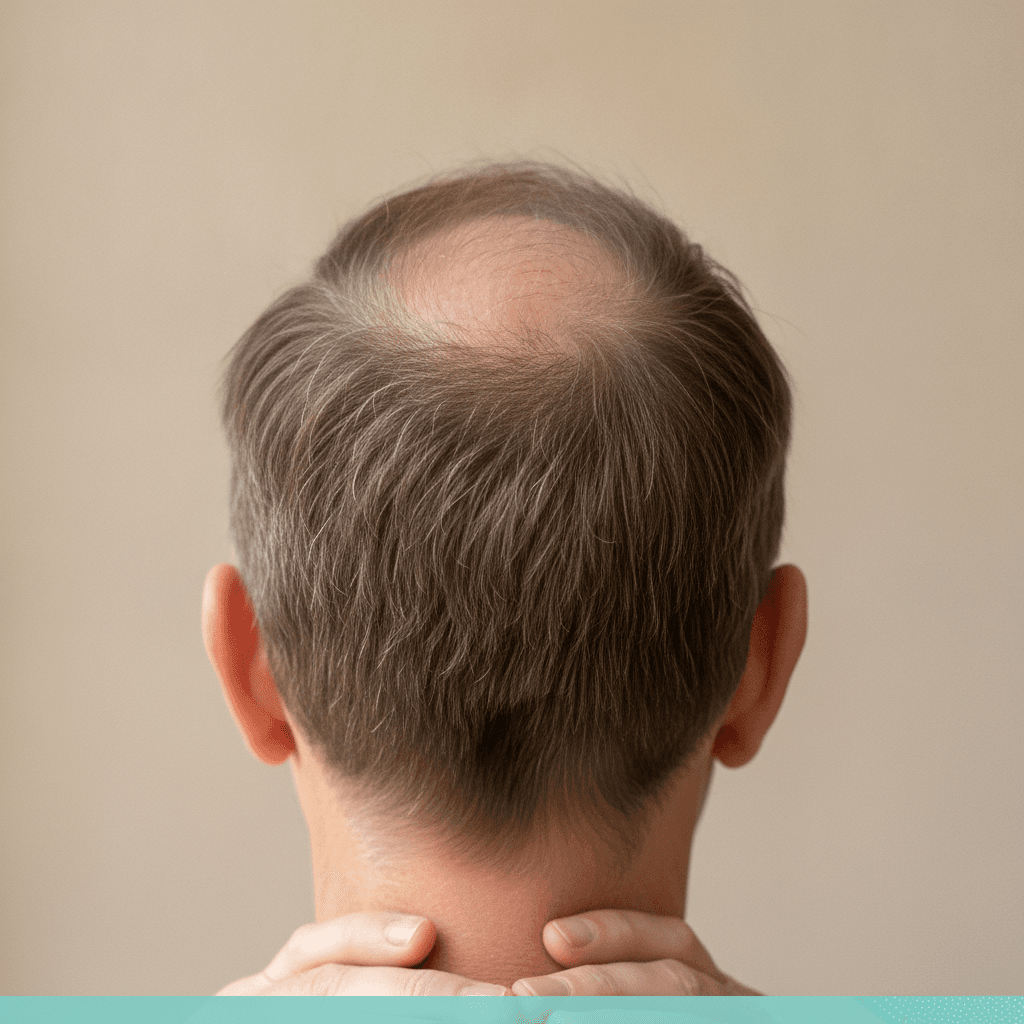
What to look for
Hair at the crown grows in a swirl, or whorl. Early thinning shows up as scalp becoming visible through that swirl, especially under bright overhead light, and as the swirl appearing to widen. The hairs in the area also get finer over time before they shorten and stop, the same miniaturization seen elsewhere in pattern loss.
How to check the back of your head
Self-checking the crown takes a small trick:
- Use two mirrors, one in front and one behind, or
- Take a phone photo or short video of the back of your head in bright light
- Repeat every couple of months in the same light and compare
Photos beat the mirror here, because a slow change is hard to judge in real time but obvious side by side.
The usual cause
Most crown thinning is androgenetic, the same pattern process behind a receding hairline. On the Norwood scale it shows up as the vertex variants, where the crown thins alongside or ahead of the hairline. Less often, a bout of telogen shedding thins the area temporarily, or a scalp condition is involved, which is why a proper look matters.
What to do
The crown responds to the same early treatment as the rest of pattern loss, and early is the operative word. Catching it while the follicles are only miniaturizing, rather than gone, keeps far more hair. So the move is not a panic, it is a timely dermatologist visit once you confirm it is thinning.
When to see a doctor
Book a visit if:
- Scalp is visibly showing through the crown swirl
- The swirl looks wider in photos taken months apart
- The crown thins alongside a receding hairline
- There is itching, soreness, scaling, or a distinct bald patch
Frequently asked questions
How do I know if my crown is thinning?+
Use two mirrors or a phone photo of the back of your head in bright light. Scalp showing through at the swirl, or a swirl that looks wider than before, points to crown thinning.
Is a thinning crown always balding?+
Most often it is androgenetic pattern loss, but telogen shedding and other causes can thin the area too. A dermatologist can tell the difference.
Can a thinning crown grow back?+
Early pattern thinning often responds to treatment, especially when started before the follicles miniaturize fully. The earlier you act, the more you keep.
Related
Sources
- American Academy of Dermatology, male pattern hair loss
- Healthline, crown and vertex hair loss resources
This article is for general education and is not medical advice. It does not replace a consultation with a qualified clinician. If a symptom worries you, see a doctor.