You catch your face in the mirror and it looks older than it did six months ago: hollower cheeks, deeper lines, a jaw that sits differently.
This page covers what "Ozempic face" is, what the studies say about why it happens, what helps your skin, and the questions to bring to a dermatologist.
Quick answer: "Ozempic face" is a nickname, not a medical diagnosis, for hollower cheeks, looser skin and more visible lines after weight loss. Dermatologists say it is partly from rapid weight loss, and that these medicines also affect collagen and muscle along with fat. The amount and speed of weight loss, age and nutrition seem to matter more than the brand name, though no study has compared faces on different medicines. Skin care and sun protection help skin quality, but no cream rebuilds lost volume, and procedures are a question for a board-certified dermatologist. Swelling of the face or lips is not this and needs emergency care. Anything about the medicine or the pace of weight loss is for the prescriber.
First, the one face change that is not Ozempic face
Swelling of the face, lips, tongue or throat, trouble breathing or swallowing, or one side of the face drooping needs 911 or the ER, not a skin cream. The Medication Guides of Ozempic, Wegovy, Mounjaro and Zepbound list swelling of the face, lips, tongue or throat and trouble breathing among the signs of a serious allergic reaction, and say to get medical help right away. Tell the emergency team which medicine you use.
What is Ozempic face?
It is a public nickname, not a condition with a test. The American Academy of Dermatology (AAD) says patients notice less plumpness in the face, sagging skin, wrinkles and a crepe-like texture. Clinicians describe hollowing, skin laxity and contour changes that can make existing signs of aging more obvious (Frank and colleagues, 2026). A 2025 systematic review of 23 plastic surgery articles says the term was coined for exaggerated volume loss that looks like advanced aging, and that online searches for it rose alongside searches for face filler (Daneshgaran and colleagues).
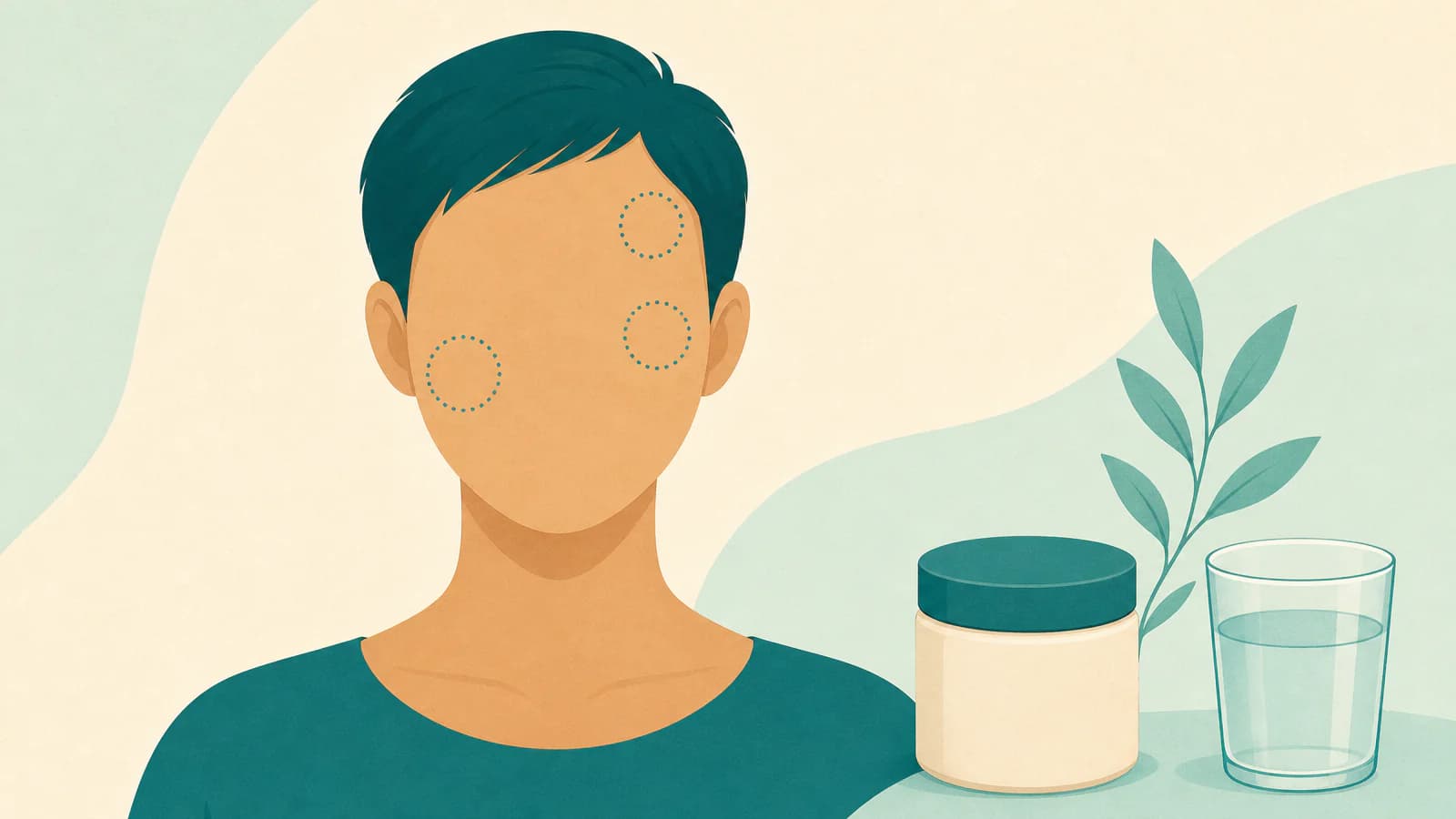
We do not show before and after photos here. The illustration marks the areas people mention most.
Why does it happen?
Mostly, the face is losing the padding under the skin. Facial fat sits in separate compartments. In a 2026 narrative review, the superficial ones deflate with weight loss, support from deeper layers and bone can change, and the skin has less underneath it. Midface volume loss seems to happen mainly in the superficial compartments, which flattens the contour and sharpens the lines between areas (Frank and colleagues).
The AAD says anyone who loses weight quickly notices changes in the face, and that these medicines affect collagen and muscles along with fat cells. Not all of the weight lost is fat: in a body-composition substudy of 160 people in the SURMOUNT-1 tirzepatide trial, about 75% of the weight lost was fat and about 25% was lean mass, the same split as on placebo (Look and colleagues, 2025, Eli Lilly authors).
How much you lose seems to matter. A 2026 survey of 1,226 people taking GLP-1 medicines for weight management asked what they had noticed, grouped by weight lost (Rao and colleagues):
| Body weight lost | Less facial volume | Skin sagging | Hair loss |
|---|---|---|---|
| Under 10% (380 people) | 13% | 15% | 17% |
| 10% to 20% (395 people) | 37% | 44% | 30% |
| Over 20% (325 people) | 50% | 72% | 52% |
The authors say the survey cannot separate the effects of the medicine from the amount and speed of weight loss. It was voluntary, relied on memory, and mostly reached white women using a telemedicine program. It shows a pattern, not your odds.
Other factors named in the literature. A 2026 systematic review of 40 studies lists older age, a long history of obesity, rapid weight loss, poor hydration and low protein intake as risk factors for more visible skin changes (Barone and colleagues). A 2024 review suggests the medicines might also affect fat tissue beyond weight loss, but says the mechanisms are not settled (Ridha and colleagues). Nobody can yet say how much of the change is the medicine and how much is the weight.
Mounjaro face vs Ozempic face
The same nickname covers both. Ozempic and Wegovy contain semaglutide. Mounjaro and Zepbound contain tirzepatide. The name stuck to Ozempic because it became famous first.
Because reports of facial change rise with weight lost, a bigger weight loss can mean a bigger change. In SURMOUNT-5, a 72-week head-to-head trial of 751 adults with obesity but without type 2 diabetes (funded by Eli Lilly), average weight change was a loss of 20.2% with tirzepatide versus 13.7% with semaglutide (Aronne and colleagues, 2025). But no study has compared faces on the two medicines. The question worth bringing to the prescriber is how much and how fast you are losing, not which name is on the pen.
What it can look like
- Hollow cheeks and temples.
- A flatter midface, where the cheeks lose their curve.
- Deeper lines from the nose to the mouth and around the mouth.
- A looser jawline and neck.
- A thinner, crepe-like skin texture (AAD).
- Eyes that look more tired or deeper set.
A 2026 survey of 406 clinicians found they see midface volume loss and face and neck skin laxity as the changes most tied to GLP-1 weight loss (Fabi and colleagues). Two of its authors work for a company that makes aesthetic products, so treat it as clinician opinion.
Sunken eyes and hollow cheeks on a GLP-1 medicine
Reviews place a lot of the change around the eyes and midface: rapid weight loss can deplete facial fat there, with skin laxity and volume loss (Bommareddy and colleagues, 2026).
But sunken eyes that appear over a few days, or come with dizziness, a very dry mouth or very dark urine, can be dehydration instead. The Medication Guides say diarrhea, nausea and vomiting may cause loss of fluids (dehydration) and kidney problems, that drinking fluids helps lower the chance of dehydration, and to tell the healthcare provider right away if nausea, vomiting or diarrhea does not go away. If that sounds like you, call the prescriber today.
Ozempic wrinkles and loose skin on the face and neck
A 2026 review of 40 studies reports visible skin changes after GLP-1 weight loss, including dermal thinning, loss of collagen and elastin fibers and lower skin elasticity (Barone and colleagues). The AAD lists wrinkles and a crepe-like texture. The neck is where loose skin tends to be noticed.
Know the limits: the evidence is mostly case reports, small studies and expert reviews. Nothing in it can tell you what your skin will do.
Ozempic lips: dry, chapped or swollen
Dry or chapped lips usually come down to dryness. The AAD lists dry skin from hormone changes and from eating and drinking less, and the Zepbound label lists dry mouth or dry throat in 1% of people on the drug versus 0.1% on placebo. Fluids and a humidifier help dry skin in general (AAD), and a plain lip balm is common sense, not a treatment claim.
Swollen lips are different. That is one of the serious allergic reaction signs, and it needs 911 or the ER. See the box above.
What helps your skin: what dermatologists recommend
Nothing in a jar rebuilds lost facial volume. A good routine does help dryness, texture and sun protection. From the AAD:
- A gentle cleanser, and a moisturizer with ceramides and antioxidants. Apply it while the skin is still damp.
- Retinoids can help decrease signs of skin aging, but may irritate and flake dry skin.
- A broad-spectrum, water-resistant sunscreen with SPF 30 or higher on all skin not covered by clothing.
- Plenty of fluids, and a humidifier (clean it regularly to prevent mold).
Nutrition matters too. One AAD dermatologist recommends a standard daily multivitamin while on a GLP-1 medicine. A 2025 joint advisory from four US societies names nutrient deficiencies from calorie reduction and muscle and bone loss as challenges, and lists preventing deficiencies and preserving muscle and bone through resistance training and an appropriate diet as priorities, with a registered dietitian as one support (Mozaffarian and colleagues). Ask the prescriber or a dietitian about protein, strength training and whether a multivitamin makes sense for you. See GLP-1 hair loss supplements for what the evidence says about protein and supplements.
Talk to a doctor before changing your routine or starting a supplement, especially in pregnancy, while breastfeeding, on other medicines, or with kidney or liver disease.
Procedures dermatologists discuss: questions to bring, not recommendations
The AAD lists soft tissue fillers to add volume, fat transfers, laser treatments to reduce wrinkles and tighten skin, and platelet-rich plasma. It says a board-certified dermatologist is the right expert. Reviews propose combinations, for example collagen stimulation with hyaluronic acid filler (Frank and colleagues) or a staged plan with fat grafting and energy devices (Bommareddy and colleagues), but those are expert proposals, not trial results.
This site does not recommend any procedure. If you decide to ask, bring these five questions:
- Which options suit my skin and my face?
- What are the risks and the recovery?
- Does timing matter while my weight is still changing?
- How long does it last, and what does it cost?
- Who will do it, and are they board-certified?
Tell every clinician which medicines you take, including your GLP-1 medicine.
Will it come back? Can you prevent it?
Nobody can give you a timeline or a promise. We found no study that follows faces for years after weight settles. Reviews suggest gradual weight loss, hydration and enough protein may help (Barone and colleagues), which is a suggestion, not proof.
Whether a slower pace fits your health is a decision for you and the prescriber. Do not change anything about your medicine on your own to manage it. And if how your face looks is weighing on you, tell your doctor that too.
Is your face red, dry or itchy, not just thinner?
That is a skin reaction question, not a volume question. Add a photo, and the photo check describes what it sees and compares it with what usually sits behind it, so you know how soon to see a doctor. It is a description, not a diagnosis.
 Tap to add a photo of the rash on your faceAI describes what it sees, which common rashes it looks like and when to see a doctor, and you get a skin care plan as a PDF. It does not diagnose. One check is $4.99.Add a photo
More in rash on GLP-1 medicines.
Related guides
- Hair loss on GLP-1 medicines: hair and face changes both rose with how much weight was lost in the survey above.
- GLP-1 hair loss supplements, for protein and nutrition.
- Rash on GLP-1 medicines, if the skin is red, itchy or flaking.
- Brittle nails on GLP-1 medicines, another change tied to weight loss.
- Skin sensitivity and burning on GLP-1 medicines, when skin hurts but looks normal.
- GLP-1 side effects on skin, hair and face, for everything else people notice.
Frequently asked questions
What is Ozempic face?+
It is a nickname, not a medical diagnosis, for hollower cheeks, looser skin and more visible lines after weight loss. The American Academy of Dermatology says it is partly caused by rapid weight loss, and that these medicines also affect collagen and muscle along with fat cells.
Does Mounjaro cause the same face changes as Ozempic?+
Both are described the same way, and no study has compared faces on the two. Ozempic contains semaglutide and Mounjaro contains tirzepatide. Reports of facial change rise with how much weight is lost, and tirzepatide produced a larger average weight loss than semaglutide in one head-to-head trial, so the amount and speed of weight loss is the better question than the brand.
Is Ozempic face permanent?+
Nobody can say. We found no study that follows faces after weight settles, so there is no honest timeline or promise. A board-certified dermatologist can explain what options exist for volume and skin quality.
Can you prevent Ozempic face?+
Nobody can promise it. A 2026 review lists older age, a long history of obesity, rapid weight loss, poor hydration and low protein intake as risk factors named in the literature, and suggests gradual weight loss, hydration and enough protein. Whether a slower pace fits your health is a decision for you and the prescriber.
Why do my eyes look sunken on a GLP-1 medicine?+
Reviews place a lot of the change around the eyes and midface, where fat tissue is lost with weight. Sudden sunken eyes can also be dehydration. Call the prescriber the same day if they come with dizziness, or with vomiting or diarrhea that will not go away.
Do face creams help with Ozempic face?+
Creams can help dryness and skin texture, and sunscreen protects skin quality. No cream rebuilds lost volume. The American Academy of Dermatology lists fillers, fat transfers, lasers and platelet-rich plasma as options dermatologists offer, and says a board-certified dermatologist is the right expert.
Are dry or swollen lips a side effect?+
Dry or chapped lips usually come down to dryness: the American Academy of Dermatology lists dry skin from eating and drinking less, and the Zepbound label lists dry mouth or dry throat. Swollen lips are different. Swelling of the lips, face, tongue or throat is a serious allergic reaction sign, so call 911 or go to the ER.
Should I see a dermatologist about my face on a GLP-1 medicine?+
The American Academy of Dermatology says a board-certified dermatologist is the right expert for cosmetic procedures and for skin side effects that do not improve with basic care. Tell them which medicines you take.
Sources
- Novo Nordisk. Ozempic (semaglutide) injection prescribing information and Medication Guide. DailyMed, label revised June 2026. DailyMed
- Novo Nordisk. Wegovy (semaglutide) injection prescribing information and Medication Guide. DailyMed, label revised June 2026. DailyMed
- Eli Lilly and Company. Mounjaro (tirzepatide) prescribing information and Medication Guide. DailyMed, label revised September 2026. DailyMed
- Eli Lilly and Company. Zepbound (tirzepatide) prescribing information and Medication Guide. DailyMed, label revised September 2026. DailyMed
- American Academy of Dermatology. How can GLP-1 drugs affect my skin, hair, and nails? Updated February 2026. aad.org
- Frank K, Guertler A, Hoffmeister V, et al. GLP-1-induced weight loss and the face: anatomical mechanisms and rationale for collagen-stimulating and volumizing aesthetic treatments. Dermatologic Surgery. 2026. PubMed 42210888
- Bommareddy K, Fabi S, Muniz M. Aesthetic considerations for preventing and managing GLP-1 receptor agonist-related facial aging. Journal of Clinical and Aesthetic Dermatology. 2026. PubMed 42761689
- Barone M, Brunetti B, D'Emilio R, et al. Effects of GLP-1 receptor agonists on skin quality: a comprehensive literature review. Aesthetic Plastic Surgery. 2026. PubMed 42162206
- Rao S, Midura I, Mangual KPS, et al. Skin impacts and tradeoffs of GLP-1 therapy: improved patient-reported outcomes of inflammatory skin disease in the era of "Ozempic face". Dermatology and Therapy. 2026. PubMed 42579223
- Ridha Z, Fabi SG, Zubair R, Dayan SH. Decoding the implications of glucagon-like peptide-1 receptor agonists on accelerated facial and skin aging. Aesthetic Surgery Journal. 2024. PubMed 38874170
- Daneshgaran G, Shauly O, Gould DJ. "Ozempic face" in plastic surgery: a systematic review of the literature on GLP-1 receptor agonist mediated weight loss and analysis of public perceptions. Aesthetic Surgery Journal Open Forum. 2025. PubMed 40626110
- Look M, Dunn JP, Kushner RF, et al. Body composition changes during weight reduction with tirzepatide in the SURMOUNT-1 study of adults with obesity or overweight. Diabetes, Obesity and Metabolism. 2025. PubMed 39996356
- Aronne LJ, Horn DB, le Roux CW, et al. Tirzepatide as compared with semaglutide for the treatment of obesity. New England Journal of Medicine. 2025. PubMed 40353578
- Fabi S, Yoo J, Kaufman-Janette J, et al. Aesthetic concerns and nonsurgical treatment trends in patients with GLP-1 agonist-associated weight loss. Dermatologic Surgery. 2026. PubMed 42210883
- Mozaffarian D, Agarwal M, Aggarwal M, et al. Nutritional priorities to support GLP-1 therapy for obesity: a joint advisory from the American College of Lifestyle Medicine, the American Society for Nutrition, the Obesity Medicine Association, and The Obesity Society. American Journal of Clinical Nutrition. 2025. PubMed 40450457
This article is for general education and is not medical advice. It does not replace a consultation with a qualified clinician. If a symptom worries you, see a doctor.