Clumps of hair in the shower drain, a thinner ponytail, and a pen you started a few months ago. Is it the Ozempic?
This page gives you the honest answer, the numbers from the FDA labels and the studies, the quick checks that tell shedding from something else, and what to do this week.
Quick answer: For most people it is a temporary shed called telogen effluvium. Fast weight loss and much less food push a batch of hairs into their resting phase, and they let go a few months later. Hair loss is on the Wegovy and Zepbound labels, and it usually settles once weight loss slows. It is not always shedding, though: round bare patches, a widening part or an itchy, burning scalp need a dermatologist. Any decision about the medicine belongs to the prescriber who prescribed it.
Not sure whether you are seeing shedding or thinning? Add two photos, your part and your crown, and the photo check describes what it sees and what usually sits behind it. It is a description, not a diagnosis.
 Shedding on a GLP-1 medicine? Tap to add a photoAI describes what it sees at your part and crown, and you get a hair recovery plan as a PDF: care steps, what to ask your doctor and a date to re-check. It does not diagnose. One check is $4.99.Add a photo
Why hair falls out on Ozempic, Wegovy, Mounjaro and Zepbound
Most of the time this is telogen effluvium. At any moment, most of your hairs are growing and a smaller share are resting. A shock to the body can push a big batch of growing hairs into rest at once. They stay put for about four months, then fall together (StatPearls). That delay is why the shedding feels random and arrives long after the cause.
On a GLP-1 medicine, the likely triggers sit side by side:
- Fast weight loss. The American Academy of Dermatology (AAD) says dermatologists believe the thinning comes from the sudden weight loss.
- Eating much less. A 2025 joint advisory from four US medical and nutrition societies puts the drop in calorie intake on these medicines at 16% to 39%. Less food can mean less protein, iron and other nutrients for hair.
- Possibly the medicine itself. The AAD notes that a direct effect on hair is possible, and that researchers need more information to say for sure.
Hair shedding after bariatric surgery is far more common than the trial numbers for these medicines. A 2026 review puts the pooled rate at 47% to 57%, which fits the weight-loss explanation. Our telogen effluvium guide covers the cycle in more detail.
How common is GLP-1 hair loss? What the labels and studies say
Ozempic and Wegovy contain semaglutide. Mounjaro and Zepbound contain tirzepatide. The FDA labels say this about hair:
| Medicine | Active ingredient | What the FDA label says |
|---|---|---|
| Wegovy | semaglutide | Pooled weight-loss trials: hair loss in 3.3% of people on the drug versus 1% on placebo. The label links it to weight reduction. |
| Zepbound | tirzepatide | Pooled weight-loss trials: 4% to 5% across its three dose groups versus 1% on placebo. Listed among its most common adverse reactions. Nobody on Zepbound left the trials because of hair loss. |
| Ozempic | semaglutide | Alopecia appears among reports after approval. Those reports come from a population of unknown size, so the label says frequency cannot be estimated. |
| Mounjaro | tirzepatide | Same: alopecia among reports after approval, no trial rate. |
These rows come from different trials. They are not a ranking of the medicines.
Pooled studies from 2026 point the same way:
- A meta-analysis of 9 studies and 4,114 people found hair loss about three times as likely as on placebo, with an overall rate of 3.9%.
- A second meta-analysis, of 17 studies, found about 40% higher odds of non-scarring hair loss, driven by telogen effluvium and pattern hair loss. Patchy autoimmune hair loss (alopecia areata) was not significantly linked.
- A review of 24 studies found the highest rates with semaglutide and tirzepatide, and tirzepatide most often linked to telogen effluvium.
- A large health-records cohort study found the same association. People who developed hair loss had a lower BMI at follow-up, which fits weight loss as the driver.
Most of this evidence is observational. The authors of one 2026 commentary point out that no prospective controlled study has looked at GLP-1 hair loss specifically, so cause is not proven.
Why Reddit threads sound worse than the labels. Trial numbers count what people reported as an adverse event. A 2026 survey of 152 current and former users in Saudi Arabia, mostly women, simply asked about hair: 70.4% said they had shed after starting. Shedding was reported more by people who had lost more weight. It is a small, self-reported survey, so use it as context, not as your odds.
Hair loss on a GLP-1 medicine: women and men
Women report it more. On the Wegovy label, about 4% of women and 0.9% of men on the drug reported hair loss, versus 2% of women and no men on placebo. On the Zepbound label, it was 7.1% of women and 0.5% of men on the drug, versus 1.3% of women and no men on placebo.
Men are not off the hook. The second meta-analysis found higher odds of pattern hair loss too, and a big shed can make early pattern thinning easier to see. If you are a man and the crown or temples are what worries you, start with early signs of balding and thinning crown. Women who see a widening part should read widening part.
Is it shedding, or something else?
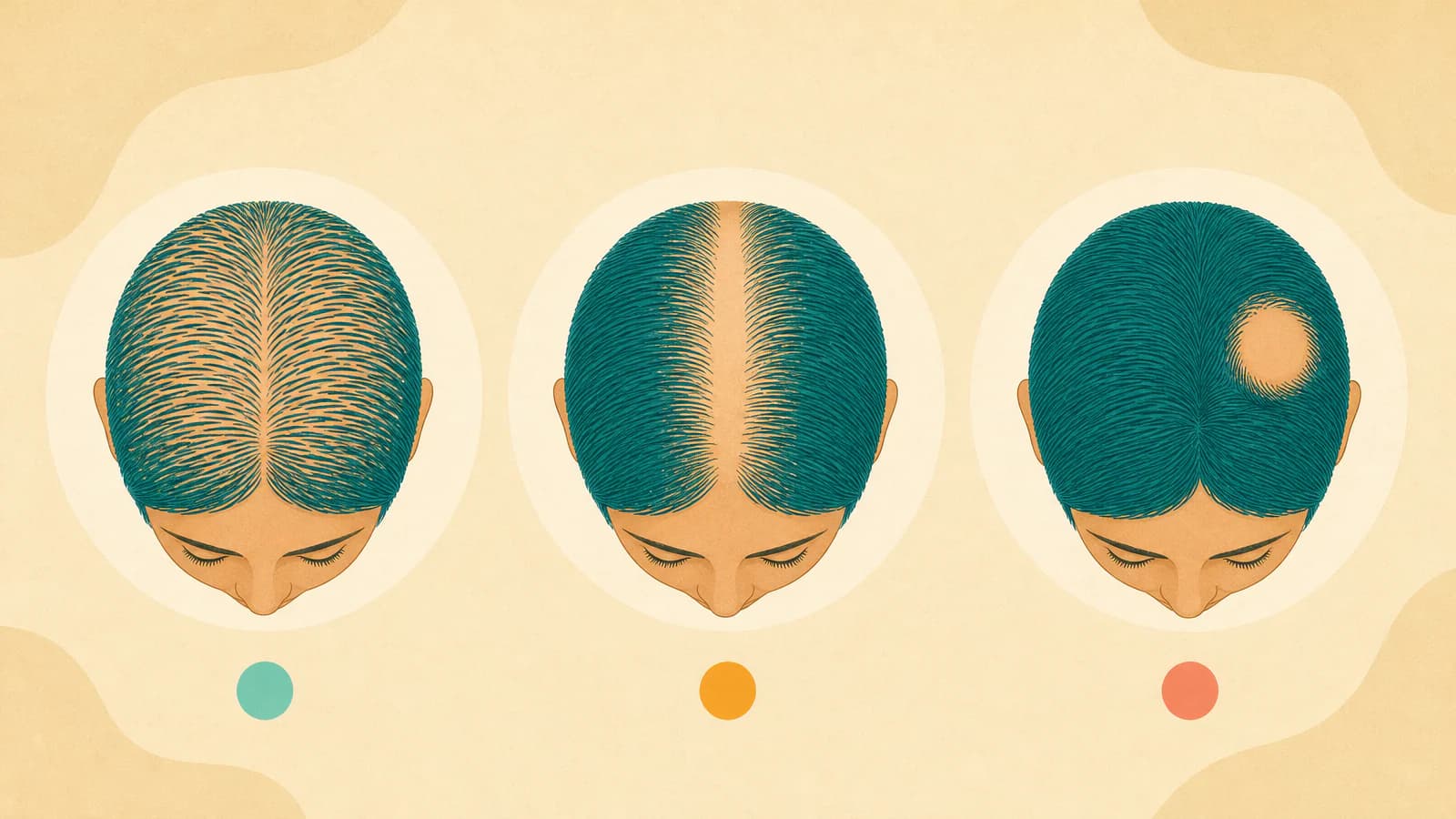
Four checks, in about a minute:
- Even or patchy? Shedding thins hair all over: a smaller ponytail, more in the drain, no bare patches. Round bare patches point toward a different condition and are worth getting looked at.
- Part and temples. A part that keeps widening, or temples that pull back, points toward pattern hair loss rather than a temporary shed.
- The scalp itself. Itch, burning, scaling, pain or smooth, shiny patches are not the usual picture of plain shedding.
- How long. Heavy shedding that lasts beyond six months is called chronic in our telogen effluvium guide and deserves a doctor's look.
Normal is 50 to 100 hairs a day, according to the AAD. See how much hair loss is normal and shedding vs hair loss for how to count.
When does it start, and will it grow back?
It usually starts a few months after weight loss begins, and the AAD says hair tends to regain its normal fullness within six to nine months once the trigger settles. The month-by-month picture, including what happens after stopping, is in the regrowth timeline.
What to do about hair loss on a GLP-1 medicine
- Tell the prescriber. Hair loss is a known effect. They can look at your pace of weight loss, your eating and your health. The AAD warns that serious side effects can occur if you suddenly stop a treatment, so do not change anything on your own.
- Put protein and meals first. Low protein intake is a known trigger for this kind of shed. The numbers, and what is and is not worth buying, are on the page about GLP-1 hair loss supplements.
- Ask which blood tests make sense. Iron stores and thyroid are on the usual list, because iron shortage and an underactive thyroid are known triggers. Your doctor decides.
- Be gentle with the hair you have. Loose styles, less heat, no harsh chemical treatments while it settles.
- Photograph your part and crown monthly, in the same light, so you can see the trend.
- See a dermatologist if any red flag below applies. The AAD says the best first step is a dermatologist who can name the exact type of hair loss.
The AAD also says people prone to hair loss should lose weight slowly. Whether that is possible for you is a decision to make with your prescriber. Talk to a doctor before starting any supplement or treatment, especially in pregnancy, while breastfeeding, on other medicines, or with kidney or liver disease.
Do shampoos and hair products help?
Probably not, though the evidence is missing rather than negative. None of the GLP-1 hair loss studies above tested a shampoo, and a shampoo cannot change what is happening in the follicle. Choose a gentle one that suits your scalp. If your scalp flakes or itches, that is its own problem: see dandruff vs dry scalp.
Itchy or sore scalp while losing hair on a GLP-1
Plain shedding is not usually itchy. A scalp that itches, burns or flakes is worth a look, and it can happen at the same time as shedding. Dry skin is one of the effects the AAD lists for these medicines. The itchy scalp guide walks through the common causes. On brown and Black skin, redness can look darker brown, purple or gray, so go by warmth, swelling and texture too.
When to see a dermatologist
- Round bare patches.
- A part that keeps widening or a receding hairline.
- Itch, burning, scaling, pain, or smooth, shiny patches on the scalp.
- Heavy shedding beyond six months.
- Unusual tiredness or feeling cold, or you are eating very little or cannot keep food down.
- Hair loss that began before you started the medicine. The AAD says to tell your dermatologist before you start.
A dermatologist can tell shedding from pattern loss and look for the cause. A 2026 Cleveland Clinic review notes that telogen effluvium is recognised mainly from your history and an examination of the scalp.
Seen the signs and still unsure which row you are in? Upload your photos and compare what the photo check describes with what you just read.
Shedding on a GLP-1 medicine? Tap to add a photoAI describes what it sees at your part and crown, and you get a hair recovery plan as a PDF: care steps, what to ask your doctor and a date to re-check. It does not diagnose. One check is $4.99.Add a photo
Related guides
- Will hair grow back? The timeline, for what the months ahead usually look like.
- GLP-1 hair loss supplements, for protein, labs and what is worth buying.
- Telogen effluvium, for how the shedding cycle works.
- Shedding vs hair loss, if you are not sure which one you have.
- GLP-1 side effects on skin, hair and face, for everything else people notice.
Frequently asked questions
Does Ozempic cause hair loss?+
It can be linked to it. The Ozempic label lists alopecia among reports after approval, but those reports cannot show how often it happens or prove cause. The Wegovy label, built on weight-loss trials of the same drug, does give a number: 3.3% on the drug versus 1% on placebo.
Do Mounjaro and Zepbound cause hair loss too?+
Yes, both contain tirzepatide and hair loss is on both labels. Zepbound lists it among its most common adverse reactions: 4% to 5% of people on the drug in its weight-loss trials versus 1% on placebo. Mounjaro lists alopecia among reports after approval.
Is hair loss from a GLP-1 medicine permanent?+
Usually not. The common kind is a temporary shed that grows back once the trigger settles, which the American Academy of Dermatology puts at six to nine months for hair to regain its normal fullness. Pattern thinning is a different problem and can show up at the same time, so check the signs on this page.
What should I do about hair loss on Wegovy or Ozempic?+
Tell the prescriber first, so they can look at your pace of weight loss, your eating and your labs. Then eat enough protein, handle your hair gently, take a monthly photo in the same light, and see a dermatologist if you have patches, a widening part or an irritated scalp. Do not change the medicine on your own.
Can I prevent hair loss on a GLP-1 medicine?+
No one can promise it. The American Academy of Dermatology says people prone to hair loss should lose weight slowly, which is a conversation for you and your prescriber. Eating enough protein and asking about blood tests can help you catch a nutrient gap early.
Do men lose hair on a GLP-1 medicine too?+
Yes, but less often in the trials. On the Zepbound label, 0.5% of men reported hair loss versus 7.1% of women. In men, fast weight loss can also make existing pattern thinning easier to see.
Why is my scalp itchy while my hair falls out on a GLP-1 medicine?+
Plain shedding is not usually itchy, so an itchy, burning or flaking scalp is worth a look. Dry skin is one of the effects the American Academy of Dermatology lists for these medicines, and dandruff or a scalp reaction can happen at the same time as shedding.
Does shampoo help GLP-1 hair loss?+
None of the GLP-1 hair loss studies tested a shampoo, and a shampoo cannot change what is happening inside the follicle. Pick a gentle one that suits your scalp. If your scalp itches or flakes, treat that separately.
Sources
- Novo Nordisk. Wegovy (semaglutide) injection prescribing information and Medication Guide. DailyMed, label revised June 2026. DailyMed
- Eli Lilly and Company. Zepbound (tirzepatide) prescribing information and Medication Guide. DailyMed, label revised September 2026. DailyMed
- Novo Nordisk. Ozempic (semaglutide) injection prescribing information. DailyMed, label revised June 2026. DailyMed
- Eli Lilly and Company. Mounjaro (tirzepatide) prescribing information. DailyMed, label revised September 2026. DailyMed
- Cheng PL, Chang HC. Glucagon-like peptide-1 receptor agonists and hair loss: a systematic review and meta-analysis. Diabetes Research and Clinical Practice. 2026. PubMed 42155605
- Viquez Burboa GU, Flores Guillén MÁR, Duardo González VS. GLP-1 receptor agonists and alopecia: a systematic review and meta-analysis of incidence, risk, subtypes, and mechanisms. Skin Appendage Disorders. 2026. PubMed 42621629
- Gupta AK, Teasell EM, Economopoulos V, Mirmirani P. GLP-1 therapies and hair loss: a systematic review of current evidence and implications for counseling. Science Progress. 2026. PubMed 41998799
- Katragadda R, Hayden J, Saltagi AK, et al. Nonscarring alopecia in adults treated with GLP-1s: a propensity score matched TriNetX cohort study. Laryngoscope. 2026. PubMed 42647098
- Piraccini BM, Vañó-Galván S, Blume-Peytavi U, et al. Hair loss in patients on glucagon-like peptide 1 receptor agonists: understanding risks and managing outcomes. Dermatology and Therapy. 2026. PubMed 42249225
- Alharbi S, Alkhalifah A. Prevalence and predictors of hair shedding among GLP-1 receptor agonist users: a cross-sectional study from Saudi Arabia. Skin Appendage Disorders. 2026. PubMed 41799300
- Bridges AG, Jackson T. Hair and scalp effects of GLP-1 receptor agonists in practice. Clinics in Dermatology. 2026. PubMed 42767469
- Mozaffarian D, Agarwal M, Aggarwal M, et al. Nutritional priorities to support GLP-1 therapy for obesity: a joint advisory from the American College of Lifestyle Medicine, the American Society for Nutrition, the Obesity Medicine Association, and The Obesity Society. American Journal of Clinical Nutrition. 2025. PubMed 40450457
- Hughes EC, Syed HA, Saleh D. Telogen effluvium. StatPearls. 2024. PubMed 28613598
- Bergfeld WF, Mendez D. Shedding: an updated guide to a common cause of hair loss. Cleveland Clinic Journal of Medicine. 2026. PubMed 42823125
- American Academy of Dermatology. How can GLP-1 drugs affect my skin, hair, and nails? Updated February 2026. aad.org
- American Academy of Dermatology. Do you have hair loss or hair shedding? Accessed October 2026. aad.org
This article is for general education and is not medical advice. It does not replace a consultation with a qualified clinician. If a symptom worries you, see a doctor.