You have been shedding for weeks, and every few days you check your part in the mirror and wonder if this is how it looks now.
This page gives you the stage-by-stage timeline for hair that shed on Ozempic, Wegovy, Mounjaro or Zepbound, what can slow it, what is and is not known about stopping the medicine, and how to track your own regrowth.
Quick answer: In most cases, yes, it grows back. The common kind of shedding does not destroy follicles, and the American Academy of Dermatology (AAD) says hair tends to regain its normal fullness within six to nine months once the body readjusts. The catch: shedding keeps going while the trigger keeps going, and no study has timed GLP-1 hair loss to recovery, so this timeline is borrowed from shedding in general.
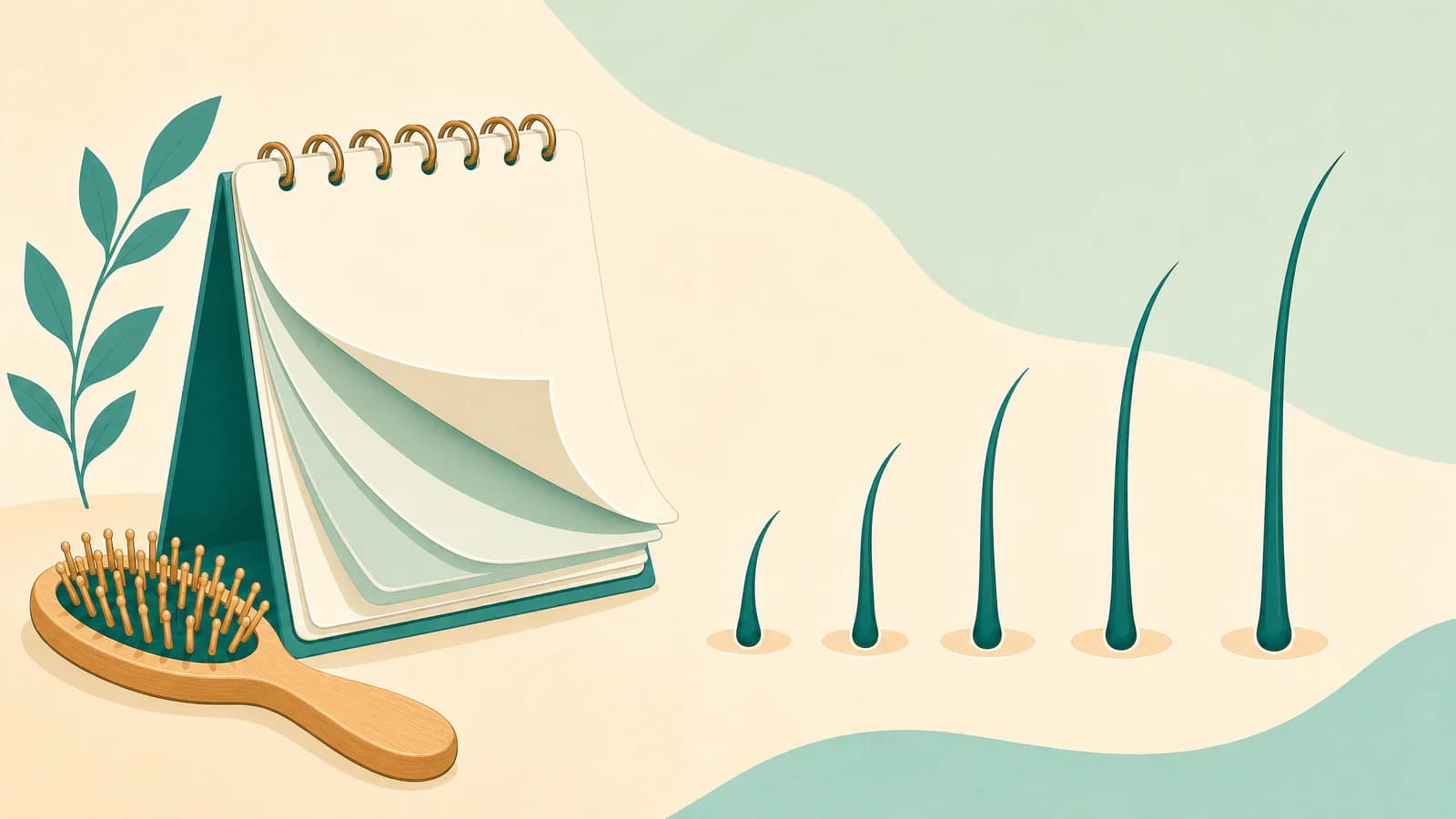
GLP-1 hair loss timeline: what usually happens
The usual cause is telogen effluvium: hairs pushed into their resting phase by a shock such as fast weight loss, eating much less, illness or childbirth (StatPearls). Here is how that tends to unfold.
| Stage | What you notice | What is going on |
|---|---|---|
| Weight is coming off fast | Nothing yet, or the normal 50 to 100 hairs a day | The trigger is in place. |
| A few months in | More hair in the shower, on the brush and pillow, a thinner ponytail | Hairs pushed into rest let go together. A resting hair stays put for about four months before a new one pushes it out. |
| The peak | The heaviest shedding | For comparison, the AAD says shedding after childbirth starts about two months after the birth and usually peaks about four months after. Your timing will differ. |
| Shedding eases | Fewer hairs per wash | The trigger has settled: weight loss slows and eating steadies. |
| Short new hairs | Fine, short hairs along the hairline and the part | Follicles that were resting have restarted. |
| Fullness returns | Hair looks and feels closer to normal | The AAD says that once the body readjusts, hair tends to regain its normal fullness within six to nine months. Long hair needs more time to grow out. |
Not sure which row you are in? Add two photos, your part and your crown, and the photo check describes what it sees and compares it with what usually sits behind it. It is a description, not a diagnosis.
 Shedding on a GLP-1 medicine? Tap to add a photoAI describes what it sees at your part and crown, and you get a hair recovery plan as a PDF: care steps, what to ask your doctor and a date to re-check. It does not diagnose. One check is $4.99.Add a photo
- Trigger · Month 0
Fast weight loss, eating much less, illness or childbirth pushes hairs into their resting phase. Nothing to see yet.
- Shedding peak · A few months in, varies
More hair in the shower, on the brush and pillow, a thinner ponytail. A resting hair stays put for about four months before a new one pushes it out. For comparison, the AAD says shedding after childbirth starts about two months after the birth and usually peaks about four months after. Your timing will differ.
- Shedding settles · When the trigger settles, varies
Fewer hairs per wash once weight loss slows and eating steadies. There is no set date. Shedding that is still heavy after six months is worth a dermatologist's look.
- Regrowth visible · After the heavy shedding eases, varies
Fine, short hairs of different lengths along the hairline and the part. Your own photos, taken every four weeks, are the best guide.
- Near-full density · Six to nine months once the body readjusts (AAD), varies
Hair looks and feels closer to normal. Long hair needs more time to grow out, so this stage can run past the 12-month mark.
A schematic, not a promise. The bars overlap and fade because timing varies from person to person. No study has timed GLP-1 hair loss to recovery, so the shape borrows from shedding in general. Pattern thinning does not follow this timeline, and a dermatologist can tell the two apart.
When does GLP-1 hair loss stop?
When the trigger settles, not on a calendar date. The AAD says that if the stressor stays, shedding can be long-lived. On a GLP-1 medicine, that means weight still dropping fast or eating very low.
A 2025 joint advisory from four US medical and nutrition societies puts the drop in calorie intake on these medicines at 16% to 39%, and lists excessive hair loss among the signs of a nutrient shortfall. The AAD adds that people prone to hair loss should lose weight slowly. Pace and eating are things to raise with the prescriber, not to adjust on your own. The main GLP-1 hair loss guide covers the causes in full.
Will hair grow back if I stay on Ozempic or Mounjaro?
Usually yes. A 2026 Cleveland Clinic review describes telogen effluvium as common, non-scarring and typically reversible, with gradual regrowth over time. Once weight loss slows, hair can recover while you are still on the medicine. The Wegovy and Zepbound labels both link their hair loss reports to weight reduction, and nobody on Zepbound left its trials because of hair loss.
The honest limit: a 2026 commentary notes that no prospective controlled study has specifically followed GLP-1 hair loss, and cause has not been established. The recovery pattern is inferred from how this kind of shedding behaves in general.
Hair loss after stopping Ozempic, Wegovy, Mounjaro or Zepbound
Hair can recover whether or not someone stays on the medicine. The leading explanation for the shed is weight-loss stress, not a switch that flips on the day of the last injection, although cause has not been proven.
One small survey of 152 current and former users in Saudi Arabia (2026) is the closest thing to data. Among people who had shed, 37.7% said it resolved after they stopped treatment. But a survey cannot separate the medicine from the weight loss, it cannot tell you what would have happened had they stayed on it, and it is self-reported.
The AAD warns that serious side effects can occur if you suddenly stop a treatment, and that if you suspect a drug is causing hair loss you should talk with your doctor. So this page will not tell you to stay on a medicine or to leave it. If hair is what worries you, say so to the prescriber who prescribed it. They can look at pace, protein, blood tests and options, and hair is only one of the things they weigh.
What can slow or block regrowth
- The trigger continuing. Fast weight loss or very low eating keeps pushing hairs into rest.
- Low protein, low iron or an underactive thyroid. StatPearls lists all three as triggers. Ask your doctor which blood tests make sense. Nutrition basics are in the page on GLP-1 hair loss supplements.
- Pattern hair loss at the same time. A 2026 meta-analysis of 17 studies found higher odds of both telogen effluvium (1.76) and pattern hair loss (1.64) at 12 months. Pattern thinning does not return on its own the way shedding does. See widening part and thinning crown for the signs.
- A scalp problem. Itch, scaling or burning is not part of plain shedding and needs its own look.
Ozempic hair loss before and after: how to track your own
We do not publish before-and-after photos of other people. Lighting, hair length and angle change how thin hair looks more than the hair does. Make your own comparison instead:
- Same room, same light, same distance from the camera.
- Dry hair, parted in the same place.
- One photo of the part line and one of the crown, every four weeks.
- Put them side by side. Look for short new hairs of different lengths along the hairline and the part. They are the first sign of regrowth.
For how many hairs a day count as normal, see how much hair loss is normal.
When to see a doctor
- Shedding that is still heavy after six months.
- Round bare patches.
- A part that keeps widening, or a hairline that is receding.
- Itch, burning, scaling or pain on the scalp.
- Unusual tiredness or feeling cold, or you are eating very little.
- No short new hairs even though the shedding has clearly eased.
A dermatologist can tell shedding from pattern loss and look for causes. For anything about the medicine itself, talk to the prescriber who prescribed it, especially in pregnancy, while breastfeeding, on other medicines, or with kidney or liver disease.
Related guides
- Hair loss on GLP-1 medicines: why it happens and what to do, for the causes and the numbers behind them.
- Telogen effluvium, for how the shedding cycle works.
- Shedding vs hair loss, if you are not sure which one you have.
- GLP-1 hair loss supplements, for protein, blood tests and what is worth buying.
- GLP-1 side effects on skin, hair and face, for everything else people notice.
Frequently asked questions
Will my hair grow back after Ozempic?+
In most cases, yes. The common kind of shedding is a temporary reaction to fast weight loss, and the follicles are not destroyed. The American Academy of Dermatology says hair tends to regain its normal fullness within six to nine months once the body readjusts.
When does hair loss from Mounjaro or Zepbound stop?+
When the trigger settles, which usually means weight loss slows and eating steadies. There is no set date, and shedding can continue while the weight keeps dropping fast. Talk to the prescriber about your pace and your nutrition.
How long does GLP-1 hair loss last?+
Usually months, not weeks. Resting hairs stay in place for about four months before they fall, and fullness takes longer to return. Shedding that is still heavy after six months is worth a dermatologist's look.
Will hair grow back after I stop Wegovy?+
Hair can recover whether or not someone stays on the medicine, since the leading explanation is weight-loss stress. In one small survey, some people said shedding resolved after they stopped, but a survey cannot separate the medicine from the weight loss. Any decision about the medicine belongs to the prescriber.
Can GLP-1 hair loss become permanent?+
Shedding of this kind is usually reversible. Pattern thinning is a different condition: it does not return on its own and may need treatment. A dermatologist can tell which one you have.
Is regrowth visible before six months?+
Short new hairs can show up along the hairline and part once the heavy shedding eases, which can be sooner than full density. No study has mapped the exact timing for GLP-1 medicines, so use your own monthly photos as the guide.
Why is my hair still falling out months after my weight stabilized?+
The American Academy of Dermatology describes six to nine months for fullness to return once the body readjusts, so shedding can linger. Low iron, low protein or a thyroid problem can also keep it going. If it is still heavy past six months, see a doctor.
Sources
- Hughes EC, Syed HA, Saleh D. Telogen effluvium. StatPearls. 2024. PubMed 28613598
- Bergfeld WF, Mendez D. Shedding: an updated guide to a common cause of hair loss. Cleveland Clinic Journal of Medicine. 2026. PubMed 42823125
- Piraccini BM, Vañó-Galván S, Blume-Peytavi U, et al. Hair loss in patients on glucagon-like peptide 1 receptor agonists: understanding risks and managing outcomes. Dermatology and Therapy. 2026. PubMed 42249225
- Viquez Burboa GU, Flores Guillén MÁR, Duardo González VS. GLP-1 receptor agonists and alopecia: a systematic review and meta-analysis of incidence, risk, subtypes, and mechanisms. Skin Appendage Disorders. 2026. PubMed 42621629
- Alharbi S, Alkhalifah A. Prevalence and predictors of hair shedding among GLP-1 receptor agonist users: a cross-sectional study from Saudi Arabia. Skin Appendage Disorders. 2026. PubMed 41799300
- Mozaffarian D, Agarwal M, Aggarwal M, et al. Nutritional priorities to support GLP-1 therapy for obesity: a joint advisory from the American College of Lifestyle Medicine, the American Society for Nutrition, the Obesity Medicine Association, and The Obesity Society. American Journal of Clinical Nutrition. 2025. PubMed 40450457
- Novo Nordisk. Wegovy (semaglutide) injection prescribing information. DailyMed, label revised June 2026. DailyMed
- Eli Lilly and Company. Zepbound (tirzepatide) prescribing information. DailyMed, label revised September 2026. DailyMed
- American Academy of Dermatology. Do you have hair loss or hair shedding? Accessed October 2026. aad.org
- American Academy of Dermatology. How can GLP-1 drugs affect my skin, hair, and nails? Updated February 2026. aad.org
This article is for general education and is not medical advice. It does not replace a consultation with a qualified clinician. If a symptom worries you, see a doctor.