You look down at your hands and a nail has split again, or peeled in thin layers, or barely seems to have grown since you started the pen. Is it the medicine?
This page covers what dermatologists say about nails on GLP-1 medicines, how long nails take to recover, what helps, and the few signs that should go to a doctor.
Quick answer: The American Academy of Dermatology (AAD) lists slower nail growth and brittle nails from significant weight loss among the effects patients report on these medicines. The prescribing information for Ozempic, Wegovy, Mounjaro and Zepbound does not list nail changes. Nails take months to grow out, so what you see now started months ago. Gentle nail care and a talk with the prescriber or a dietitian about nutrition are the main steps. A new dark line, or a hot, swollen nail fold, needs a doctor. Anything about the medicine itself is for the prescriber.
Get help first: nail changes that need a doctor
Most nail changes on this page can wait for an appointment. These cannot:
- A new dark line under a nail, or one that gets wider or darker.
- Dark color spreading onto the skin around the nail.
- A red, hot, swollen nail fold with pus.
- Fingertips that swell, with nails curving over them.
- Nails that change, swell or cause pain: the AAD says to see a dermatologist.
- Any nail problem at all if you have diabetes or poor circulation (AAD). Many people take these medicines for type 2 diabetes.
Why GLP-1 medicines can affect your nails
The AAD lists slower nail growth and brittle nails from significant weight loss among the effects patients report, and links many of these effects to fast weight loss and to eating and drinking less. A nail is mostly keratin protein with minerals including iron, zinc and copper, and virtually every nutritional deficiency can affect nail growth in some way (Cashman and Sloan, 2010).
A 2025 joint advisory from four US societies puts the drop in calorie intake on these medicines at 16% to 39% and names nutritional deficiencies from calorie reduction as a challenge (Mozaffarian and colleagues). A 2019 review lists the micronutrients that most often show up in skin, hair and nail changes when intake or absorption is poor: biotin, vitamin B12, vitamin C, vitamins A, E and K, zinc, iron, copper, selenium and essential fatty acids (DiBaise and Tarleton).
Here is the honest limit. We found no study of nails on these medicines, and nail changes are not on the four labels. What is known is the dermatologists' account of weight loss effects, plus what is known about nails and nutrition.
What nail changes look like on a GLP-1 medicine
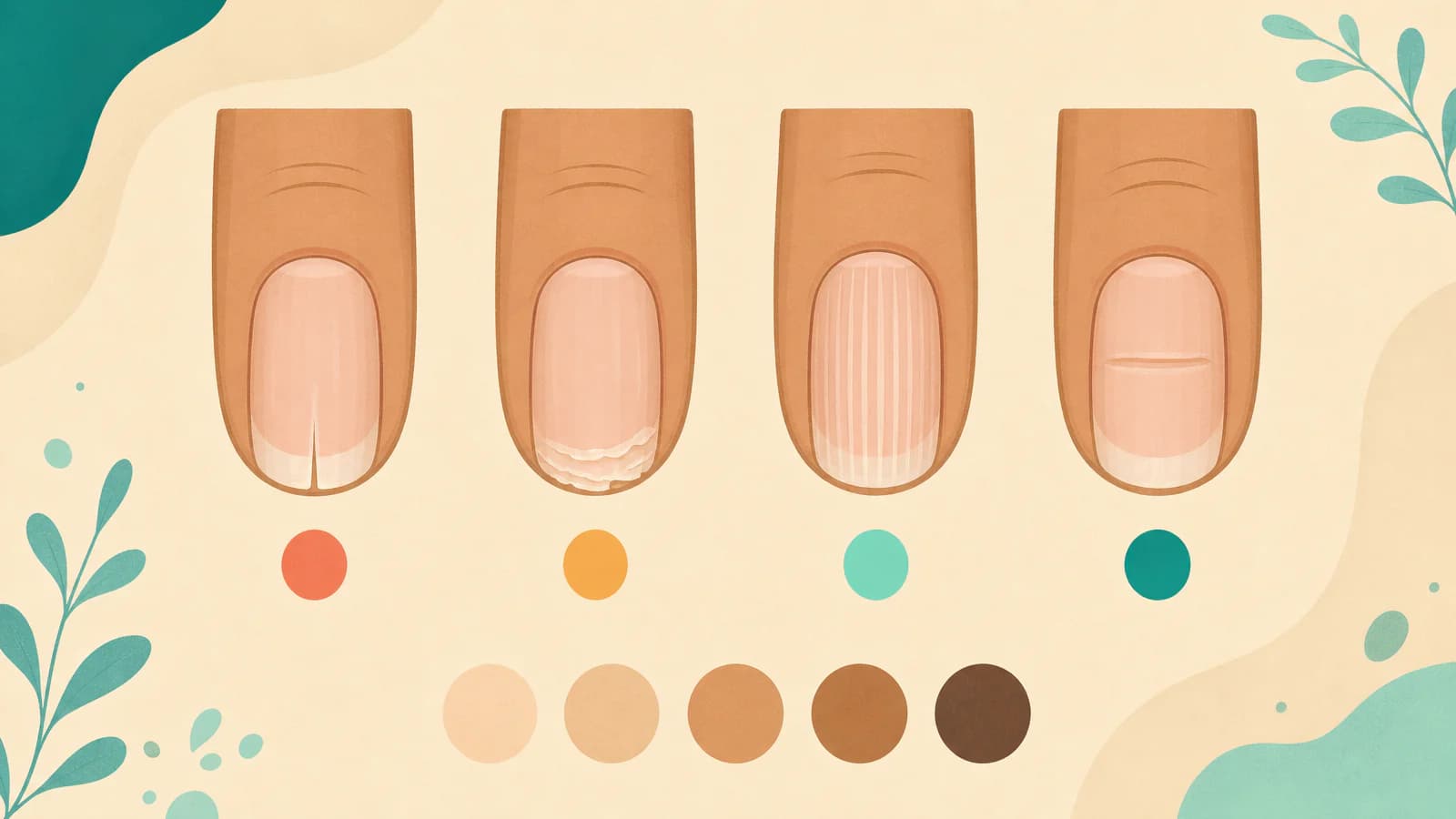
- Splitting or breaking. Brittle nails have two main features: peeling in layers (onychoschizia) and splitting or ridging (onychorrhexis) (van de Kerkhof and colleagues, 2005).
- Peeling in layers. See peeling nails.
- Slow growth. Fewer clippings, and a nail that takes longer to reach the fingertip.
- Vertical ridges. Fine lines from cuticle to tip. See vertical ridges.
- A groove across the nail (Beau's line). A groove caused by reduced activity of the nail-forming cells at the base (Leggit, 2025). It marks a temporary pause in growth that can follow systemic illness, malnutrition, a medication effect or injury, and it grows out with the nail (Cohen, 2025). See horizontal ridges.
- Spoon-shaped nails can go with low iron. See spoon nails.
How long until my nails recover?
A nail grows about 2 to 3 mm a month, and complete replacement takes 6 to 9 months (Cashman and Sloan, 2010). So the damage you see at the tip started months ago, and new nail grows in from the base. A groove forms at the cuticle and moves toward the tip as the nail grows.
Nobody can promise a date, and the timeline depends on the cause. A practical habit: look at the base of the nail, not the tip, and take one photo a month in the same light.
Brittle nails are common anyway
Brittle nails affect up to about 20% of people, most prominent in older women and on fingernails (Leggit, 2025). Women are affected about twice as often as men (van de Kerkhof and colleagues). So the medicine is not always the reason. Water, harsh products and nail habits matter a lot. Our general guide to brittle and splitting nails covers those causes.
What helps brittle nails on a GLP-1 medicine
Nail care, from the AAD:
- Protect nails from water. Too much water exposure can weaken nails so they split, peel or break. Wear gloves for cleaning and dishes, and moisturize after washing your hands.
- Moisturize your whole body, including your cuticles.
- Keep nails clean and dry.
- Cut nails straight across with sharp clippers, round the tips slightly, and file with an emery board.
- Do not bite nails or remove the cuticle, and do not use nails as tools.
Nutrition and checks to bring to the prescriber or a registered dietitian:
- Ask about protein and a daily multivitamin. One AAD dermatologist recommends a standard multivitamin while on a GLP-1 medicine.
- The 2025 joint advisory lists preventing nutrient deficiencies and preserving muscle and bone through resistance training and an appropriate diet as priorities, with dietitian counseling as one support.
- Ask which blood tests make sense. Iron and zinc are among the minerals reviews tie to nail changes.
Talk to a doctor before starting any supplement, especially in pregnancy, while breastfeeding, on other medicines, or with kidney or liver disease.
Biotin and other nail supplements: what the evidence says
In small trials, oral biotin was associated with firmer, harder and thicker brittle nails, and larger controlled trials are still needed (Lipner and Scher, 2018). A 2026 review found a lack of solid evidence that vitamin supplements improve general nail health, with variable results for biotin and vitamin E, and says indiscriminate supplement use is not uniformly beneficial and may carry risks (Singal and Bisherwal). Supplements make sense for a deficiency, and a deficiency is something a blood test shows.
Biotin warning from the FDA: biotin, often found in supplements, can interfere with some lab tests and cause incorrect results that may go undetected, including falsely low troponin results (troponin tests are used to check for a heart attack). Tell your doctor and the lab if you take it.
The full run-down is in vitamins for nails.
Toenail changes on a GLP-1 medicine
Physical trauma is the most common cause of toenail damage, more common than fungus, and ill-fitting shoes strain the toes in ways that often look like fungus (Ricardo and colleagues, 2026). The AAD advises trimming toenails regularly and keeping them short, wearing shoes that fit, and wearing flip flops at the pool and in public showers to lower the risk of fungal infection.
If a nail is crumbly or yellow, rule fungus out: see nail fungus signs. People with diabetes or poor circulation should have any toenail problem looked at.
Hair shedding at the same time?
The AAD lists thinning hair and brittle nails side by side among the effects tied to weight loss and eating less. Hair shedding tends to show up a few months after the weight starts coming off. If yours has, add two photos of your part and crown, and the photo check describes what it sees. It is a description, not a diagnosis.
 Shedding on a GLP-1 medicine? Tap to add a photoAI describes what it sees at your part and crown, and you get a hair recovery plan as a PDF: care steps, what to ask your doctor and a date to re-check. It does not diagnose. One check is $4.99.Add a photo
More in hair loss on GLP-1 medicines, the regrowth timeline for what the months ahead look like, and GLP-1 hair loss supplements for the nutrition side.
When to see a doctor about your nails
- Any sign in the box at the top of this page, especially a dark line.
- Nail changes that are not improving as the new nail grows out.
- Pain, swelling or pus around the nail.
- Nail changes along with tiredness, hair loss, feeling cold or eating very little. A doctor can check whether nutrition or something else is behind it.
A board-certified dermatologist can look at nail changes, and the AAD advises seeing one if side effects do not improve with basic care.
Related guides
- Brittle and splitting nails, the general guide to causes.
- Peeling nails and vertical ridges.
- Vitamins for nails and vitamin deficiency signs in nails.
- Hair loss on GLP-1 medicines, for the other change that follows weight loss.
- GLP-1 side effects on skin, hair and face, for everything else people notice.
Frequently asked questions
Does Ozempic cause brittle nails?+
The American Academy of Dermatology lists brittle nails and slower nail growth from significant weight loss among the effects patients report on these medicines. The Ozempic label does not list nail changes, and a direct cause has not been shown. If it bothers you, tell the prescriber.
Can Wegovy, Mounjaro or Zepbound affect my nails too?+
The American Academy of Dermatology describes these nail changes for GLP-1 drugs as a class, not for one brand, and links them to significant weight loss. None of the four labels list nail changes.
Will my nails grow back normal after weight loss?+
A nail takes about 6 to 9 months to be fully replaced, and new nail grows in from the base, so a change you see at the tip started months ago. Nobody can promise a date. Gentle care and a nutrition check support the new growth.
Should I take biotin for brittle nails on a GLP-1 medicine?+
The evidence is limited. Small trials found firmer, thicker nails with oral biotin and larger controlled trials are still needed, and a 2026 review found little solid evidence that vitamin supplements improve nail health. The FDA warns that biotin can distort lab tests, including troponin tests for a heart attack. Ask a doctor first, and tell your lab if you take it.
Why are my toenails changing on Ozempic?+
Physical trauma is the most common cause of toenail damage, more common than fungus, and ill-fitting shoes strain the toes. Weight loss can also affect nail growth. See a doctor if the nail is painful or swollen, or if you have diabetes or poor circulation.
Why do I have ridges in my nails since losing weight?+
Lines running from the cuticle to the tip are vertical ridges, covered in our vertical ridges guide. A groove across the nail is a Beau's line, a temporary pause in nail growth that can follow illness, malnutrition, a medication effect or injury, and it grows out with the nail.
Are my nails a sign of a vitamin deficiency?+
They can be, but the signs are nonspecific. Reviews note that nutritional deficiencies can affect nail growth and that the changes can have many causes. A doctor can test your levels, which beats guessing with supplements.
Sources
- Novo Nordisk. Ozempic (semaglutide) injection prescribing information. DailyMed, label revised June 2026. DailyMed
- Novo Nordisk. Wegovy (semaglutide) injection prescribing information. DailyMed, label revised June 2026. DailyMed
- Eli Lilly and Company. Mounjaro (tirzepatide) prescribing information. DailyMed, label revised September 2026. DailyMed
- Eli Lilly and Company. Zepbound (tirzepatide) prescribing information. DailyMed, label revised September 2026. DailyMed
- American Academy of Dermatology. How can GLP-1 drugs affect my skin, hair, and nails? Updated February 2026. aad.org
- American Academy of Dermatology. 11 dermatologists' tips for healthy nails. Updated February 2025. aad.org
- Cashman MW, Sloan SB. Nutrition and nail disease. Clinics in Dermatology. 2010. PubMed 20620759
- DiBaise M, Tarleton SM. Hair, nails, and skin: differentiating cutaneous manifestations of micronutrient deficiency. Nutrition in Clinical Practice. 2019. PubMed 31144371
- Leggit JC. Nail abnormalities. American Family Physician. 2025. PubMed 41118185
- van de Kerkhof PC, Pasch MC, Scher RK, et al. Brittle nail syndrome: a pathogenesis-based approach with a proposed grading system. Journal of the American Academy of Dermatology. 2005. PubMed 16198786
- Cohen PR. Dermatology (Beau's lines) and forensic pathology (Harris lines and linear enamel hypoplasia) signs of growth arrest: a case report and literature review. Cureus. 2025. PubMed 40600092
- Lipner SR, Scher RK. Biotin for the treatment of nail disease: what is the evidence? Journal of Dermatological Treatment. 2018. PubMed 29057689
- Singal A, Bisherwal K. Vitamins and nail: in health and diseases. Clinics in Dermatology. 2026. PubMed 41690653
- Ricardo JW, Dominguez-Cherit J, Haneke E, et al. Evaluation and management of mechanical and structural nail disorders: a clinical review. Journal of the American Academy of Dermatology. 2026. PubMed 41242632
- Mozaffarian D, Agarwal M, Aggarwal M, et al. Nutritional priorities to support GLP-1 therapy for obesity: a joint advisory from the American College of Lifestyle Medicine, the American Society for Nutrition, the Obesity Medicine Association, and The Obesity Society. American Journal of Clinical Nutrition. 2025. PubMed 40450457
- U.S. Food and Drug Administration. Biotin interference with troponin lab tests: assays subject to biotin interference (safety communication 2017, updated 2019). 2019. fda.gov
This article is for general education and is not medical advice. It does not replace a consultation with a qualified clinician. If a symptom worries you, see a doctor.